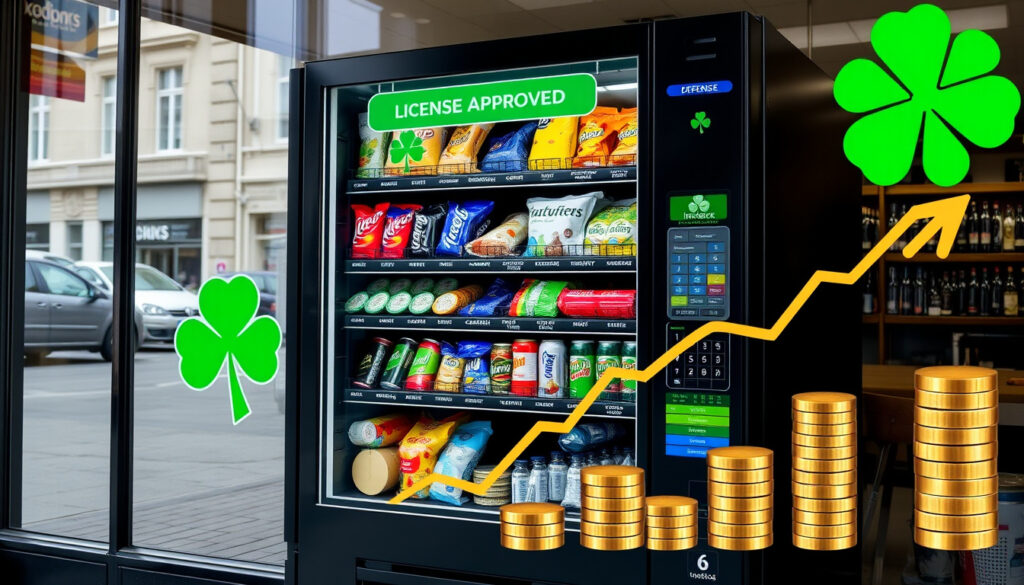
Vending Machine Ireland: License, Costs, and Profitability
Anyone who has priced a vending machine, looked up Irish business licences, or simply wondered whether the snack dispenser in an office lobby actually turns a profit has already stumbled onto a puzzle involving tax, regulation, and investment risk. The industry’s own numbers paint a mixed picture: a machine can cost anywhere from €650 to €6,800, and the profit margin reported by local operators usually lands between 10 and 20 percent.
Vending machine price range in Ireland: €650 – €6,800 ·
Typical profit margin: 10–20% ·
Estimated machines needed for €100k annual profit: 20–40 ·
License requirement: Local permit often required
Quick snapshot
- Vending machines require local-authority permits in most Irish counties (Vending-Machines.ie licence guide)
- A new machine costs roughly €1,500 – €6,800; used models start at €650 (Vending-Machines.ie cost data)
- Tobacco-vending regulations were repealed in 2023 (Tobacco Control Laws policy database)
- Exact profit margins depend heavily on foot traffic — national averages are not published by any official body (Vending-Machines.ie earnings data)
- Whether 20 or 40 machines are needed for €100k annual profit shifts with location, product type, and operating costs (Vending-Machines.ie earnings data)
- The Public Health (Tobacco Products and Nicotine Inhaling Products) Act 2023 repealed the 2009 Vending Machine Regulations (Tobacco Control Laws policy database)
- Milk vending rules tightened after 2020 food-safety updates (Nesty food-safety guide)
- Card-based and contactless payments are becoming standard on new machines, raising compliance costs (Royal Vending business setup)
- Local authorities may introduce dedicated vending-machine licences as the market grows (Royal Vending business setup)
Five numbers capture the essentials for anyone evaluating a vending machine business in Ireland.
| Factor | Value |
|---|---|
| Vending machine price range in Ireland | €650 – €6,800 |
| Typical profit margin | 10–20% |
| Number of machines needed for €100k annual profit | 20–40 |
| License requirement | Local permit often needed |
| Most common locations | Offices, schools, hospitals, gyms |
Are vending machines profitable in Ireland?
Profitability factors in Ireland
- Foot traffic: a machine in a busy office or hospital can generate €30 in daily sales (Vending-Machines.ie earnings data)
- Product mix: snack and drink machines yield tighter margins than premium coffee or fresh-food dispensers
- Operating costs: stock, electricity, and machine maintenance can take a 10–20% cut of revenue (Vending-Machines.ie earnings data)
Average revenue per machine
Daily average: €30 · Monthly revenue: ~€900 · Margin: ~15%
Industry guides estimate that a well-placed machine in Ireland turns over roughly €30 per day, or about €900 per month (Vending-Machines.ie earnings data). At a 15% margin, that works out to roughly €135 in monthly profit before stock wastage and repair downtime. The implication: a single machine earning at the average rate will take 18–24 months to recoup its purchase price — assuming nothing breaks and foot traffic doesn’t dip.
Vending machines aren’t truly passive — stock management, coin collection, and maintenance add up to roughly two to three hours of work per machine each week, eating into that thin margin.
Comparing vending machine types
A comparison of machine types shows that upfront cost and margin vary significantly by category.
| Machine type | Typical price (new) | Typical margin | Best location |
|---|---|---|---|
| Snack & drink | €3,000 – €5,500 | 10–15% | Offices, schools |
| Coffee | €4,000 – €6,800 | 20–30% | Hospitals, retail parks |
| Fresh food (sandwiches, salads) | €5,000 – €7,000 | 15–20% | High-footfall industrial estates |
Why this matters: Coffee machines, despite a higher upfront tag, deliver the strongest margin, but they also demand more cleaning and ingredient management. Fresh-food machines face the strictest food-safety rules (Nesty food-safety guide).
Do you need a licence for a vending machine in Ireland?
Licensing requirements
- There is no single national vending-machine licence in Ireland; regulation is handled by local county or city councils (Vending-Machines.ie licence guide)
- Non-food machines (toys, electronics, stickers) often face lighter rules than food or drink dispensers
- Permit fees vary by council — some charge a small application fee, others levy an annual charge
Health and safety regulations
- Food vending machines must comply with general food-hygiene regulations (Nesty food-safety guide)
- Milk-vending machines require pasteurisation, temperature logging, and regular cleaning
- The 2023 repeal of tobacco-vending rules removed a specific national framework, leaving general retail rules in place (Tobacco Control Laws policy database)
Any operator selling perishable or unpackaged food needs a food-safety registration with the local authority, plus regular inspections. The cost of compliance hardware (refrigeration, cleaning logs) can add €500–€1,000 to startup expenses.
Tax obligations
- Operators should register as a sole trader or limited company with the Revenue Commissioners (Royal Vending business setup)
- VAT registration thresholds and requirements should be reviewed with an accountant (Royal Vending business setup)
- A dedicated business bank account is required for processing card and mobile payments (Royal Vending business setup)
The pattern is clear: Ireland’s approach to vending regulation is local and patchwork. Operators who call their county council and check food-safety rules before buying a machine save themselves the biggest headaches.
Is it worth it to buy vending machines?
Whether vending machines are “worth it” depends entirely on location, product, and operator effort — the hardware alone doesn’t guarantee a return.
Upsides
- Relatively low barrier to entry compared to a physical retail shop
- Potential for semi-passive income if machines are well-placed (Vending-Machines.ie earnings data)
- Scalable — adding machines grows income without proportional overhead
Downsides
- Upfront cost of €650–€6,800 per machine (Vending-Machines.ie cost data)
- Ongoing stock, maintenance, and cash-collection workload
- Profit margins are thin (10–20%) and sensitive to location changes
Cost-benefit analysis
Three scenarios show how upfront investment and break-even periods differ by machine type and location.
| Scenario | Upfront investment | Monthly revenue (est.) | Monthly profit (est.) | Break-even period |
|---|---|---|---|---|
| Single snack machine, mid-footfall | €3,500 | €900 | €135 | ~26 months |
| Single coffee machine, high-footfall | €5,500 | €1,200 | €300 | ~18 months |
| Five-machine bundle, mixed locations | €25,000 | €4,500 | €675 | ~37 months |
The trade-off: Coffee machines offer a shorter break-even, but they need daily ingredient checks. Mixed bundles spread risk across locations but demand a vehicle and a stock room. A single, cheap snack machine in a quiet spot is more of a hobby than a business.
How many vending machines do you need to make 100k?
Calculating revenue per machine
- Average daily sales reported by Irish suppliers: €30 (Vending-Machines.ie earnings data)
- Annual revenue per machine at that rate: ~€10,950
- Yearly profit per machine assuming 15% margin: ~€1,643
To reach a €100,000 profit target, the straight math suggests roughly 60 machines at average performance. Industry estimates in the content plan cite 20–40 machines, which likely assumes premium coffee locations or machines running well above average.
Expenses and profit margins
Annual costs per machine cover stock, electricity, maintenance, and location commissions that eat into revenue.
| Expense category | Estimated annual cost per machine |
|---|---|
| Stock replenishment | €2,500 – €3,500 |
| Electricity | €200 – €400 |
| Maintenance & repairs | €300 – €500 |
| Location commission | 10–20% of revenue |
Realistic targets
- Part-time side income (€5,000–€10,000/year): 3–6 machines
- Full-time income (€30,000–€50,000/year): 15–30 machines
- Six-figure profit (€100,000+/year): 40–60 machines
The implication: hitting six figures requires scale. Most part-time operators run fewer than 10 machines, which places them firmly in the side-income bracket. The industry’s rosy “20 machines = €100k” claim hinges on premium locations and tight cost control.
How much does a vending machine cost in Ireland?
Price ranges for new and used machines
Costs span a wide range depending on condition, brand, and payment features.
| Condition | Price range | Typical warranty |
|---|---|---|
| New (snack/drink) | €3,000 – €5,500 | 1–2 years |
| New (coffee) | €4,000 – €6,800 | 1–2 years |
| Refurbished / used | €650 – €2,500 | 90 days to 1 year |
Factors affecting cost
- Payment system (cash-only machines are cheaper, card-enabled models add €300–€600)
- Brand (Sanden, Crane, Necta) — premium brands cost more but have better parts availability
- Size and capacity (full-size vs. countertop)
Financing options
- Leasing: monthly payments as low as €130 per machine, often including maintenance (Vending-Machines.ie earnings data)
- Five-machine starter bundles: ~€36,000 + VAT (Vending-Machines.ie cost data)
- Ten-machine bundles: €60,000–€72,000 + VAT (source notes inconsistent currency)
- Working capital: budget €150 in float and €350–€450 in initial stock per machine (Royal Vending business setup)
What this means: the full cost of a single machine is closer to €5,000 once float, stock, installation, and payment-system upgrades are counted. Leasing shifts the risk to a monthly fee but locks the operator into a longer contract.
What’s clear and what’s not about vending machines in Ireland
Confirmed facts
- Vending machines require local-authority permits in most Irish counties (Vending-Machines.ie licence guide)
- A new machine costs roughly €1,500 – €6,800; used models start at €650 (Vending-Machines.ie cost data)
- Tobacco-vending regulations were repealed in 2023 (Tobacco Control Laws policy database)
What’s unclear
- Exact profit margins depend heavily on foot traffic — national averages are not published by any official body
- Whether 20 or 40 machines are needed for €100k annual profit shifts with location, product type, and operating costs
Perspectives from industry sources
Registering as a sole trader or limited company and reviewing VAT requirements with an accountant are essential first steps before placing your first machine.
— Royal Vending business guide, Ireland
Milk vending businesses must comply with pasteurisation and refrigeration standards, and operators need to register the business under food-safety rules.
— Nesty guide to Irish food vending
The 2009 Vending Machine Regulations were repealed by the 2023 Public Health Act, removing the dedicated tobacco-vending framework.
— Tobacco Control Laws policy database
For anyone considering vending machines in Ireland, the choice comes down to scale: commit to 20–40 machines and treat it as a proper logistics operation, or keep it as a single-unit experiment with realistic expectations. A single machine will not generate a full-time income, but a well-run fleet can. The data doesn’t support the passive-income story — it supports the operator who handles stock, permits, and location negotiations as a genuine business.
wendor.ai, linkedin.com, tobaccocontrollaws.org, vmfsusa.com, vendsoft.com, parkinsurance.co.uk, vending-machines.ie
Frequently asked questions
Can you run a vending machine business from home?
Do vending machines need to be serviced regularly?
What products sell best in vending machines?
How to find locations for vending machines in Ireland?
Is vending machine business tax deductible?
What is the lifespan of a vending machine?
Can you buy vending machines with financing?
Related reading
- Irish vending machine regulations
- vending machine license Ireland
More related posts
 Grok AI: Is It Free? Features, Cost, and ChatGPT Comparison
 Shawn Hatosy: Real Personality, Friendships & Background
 Mollie O’Callaghan: Age, Records, Olympic Medals and More
 CoreLogic Property Report: Get Free Reports, Compare to Appraisal
 Iran-Israel Proxy Conflict: Causes and Power Balance
 Kaia Gerber: Dating History, Health, Movies, and Net Worth (2026)
 Shaynna Blaze: Age, Net Worth, Husband and Family
 How Long Does a Cold Last? Duration, Stages, and Recovery Tips
