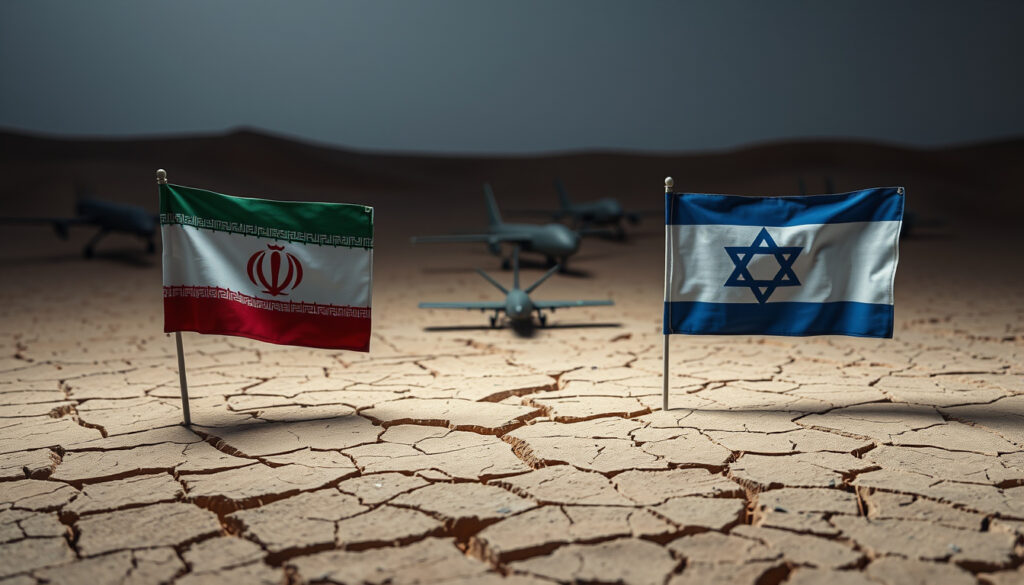
Iran-Israel Proxy Conflict: Causes and Power Balance
The rivalry between Iran and Israel is one of the most defining and dangerous conflicts in the Middle East, yet it rarely plays out as a straightforward war. For decades, it has been a shadow war fought through proxies, cyberattacks, and covert operations — a pattern that shifted dramatically in 2024 when the two countries traded direct military strikes for the first time.
Start of proxy conflict: 1985 · Diplomatic relations severed: 1979 · Countries in Axis of Resistance: 4+ · Israel’s primary ally: United States · Iran’s primary ally: Russia and China
Quick snapshot
- Proxy conflict active since 1985 (Wikipedia (General encyclopedia))
- Iran launched 300+ drones at Israel in April 2024 (Euronews (European news network))
- Exact timeline of Iranian nuclear weapon development
- Scope of future direct military engagement between Iran and Israel
- Israel is widely believed to have a nuclear arsenal
- June 2025: Israel struck key Iranian nuclear and military sites (Washington Examiner (U.S. political news outlet))
- Ceasefire holds but underlying proxy war continues (Wikipedia (General encyclopedia))
- Nuclear negotiations remain stalled (CFR (U.S. foreign policy think tank))
Five key figures, one pattern: a proxy conflict that escalated into direct state-on-state warfare in 2024–2025, with military spending and alliance networks determining the balance of power.
| Metric | Value |
|---|---|
| Established proxy conflict | 1985 |
| Iranian proxies | Hezbollah, Hamas, Houthis, Syrian militias |
| Israel’s military spending (2024) | $27.5 billion |
| Iran’s military spending (2024) | $10 billion |
| US aid to Israel (annual) | $3.8 billion |
What exactly is the issue between Israel and Iran?
Origins of the hostility since 1979
- The Iranian Islamic Revolution of 1979 overthrew the pro-Western Shah and established a Shia theocracy under Ayatollah Khomeini, who broke diplomatic ties with Israel (Wikipedia (General encyclopedia)).
- Iran does not recognize Israel’s right to exist and has called for its destruction as a central tenet of its foreign policy (CFR (U.S. foreign policy think tank)).
- Proxy conflict began in 1985 when Israeli forces withdrew from Lebanon and Iran-backed Hezbollah filled the vacuum (Wikipedia (General encyclopedia)).
The role of the Islamic Revolution
- Khomeini’s ideology positioned Israel as a “Zionist entity” that should not exist on Islamic land (Wikipedia (General encyclopedia)).
- Iran views Israel as a proxy of the United States and a tool to rally anti-Western sentiment across the Muslim world (Pakistan Social Sciences Review (Academic journal on Middle East policy)).
- The revolution transformed Iran from a pre-1979 ally of Israel — Tehran supplied oil and recognized the state — into its most ideological adversary (Wikipedia (General encyclopedia)).
Iran’s nuclear program and its proxy network give it asymmetric leverage against a conventionally stronger Israel, but that same network draws Israeli preemptive strikes deeper into Iranian territory — a cycle both sides struggle to control.
The implication: the proxy mechanism that once shielded Iran now forces direct confrontation, and neither side has a clean exit.
Who is more powerful, Israel or Iran?
Military capacity comparison
- Israel has the most advanced air force in the region, including F-35 fighter jets, and a defense budget of $27.5 billion in 2024 (CFR (U.S. foreign policy think tank)).
- Iran’s military spending is roughly $10 billion, but it compensates with a massive ballistic missile arsenal and a network of proxy forces (Wikipedia (General encyclopedia)).
- CFR estimates there are between 140,000 and 185,000 IRGC-Quds Force partner forces across Afghanistan, Gaza, Lebanon, Pakistan, Syria, and Yemen (Washington Examiner (U.S. political news outlet)).
Nuclear capabilities
- Israel is widely believed to possess a nuclear arsenal, estimated at 90 to 200 warheads (CFR (U.S. foreign policy think tank)).
- Iran does not have a nuclear weapon, but its uranium enrichment program continues despite international pressure (Euronews (European news network)).
- The exact timeline of Iranian weapon development remains unclear (CFR (U.S. foreign policy think tank)).
Alliances and support networks
- Israel’s primary ally is the United States, which provides $3.8 billion in annual military aid (Washington Examiner (U.S. political news outlet)).
- Iran leans on Russia and China for diplomatic cover, and on its Axis of Resistance — Hezbollah, Hamas, Houthis, Syrian militias — for theater-level operations (Euronews (European news network)).
- During the 2025 war, the United States struck three Iranian nuclear sites after entering the conflict offensively on 22 June 2025 (Washington Examiner (U.S. political news outlet)).
The implication: Israel holds a technological and nuclear edge, but Iran’s proxy depth and missile range mean neither side can win decisively on their own turf. The U.S. intervention in June 2025 tilted the military balance but also risked bringing a larger power into the conflict directly.
Why is Israel so important to Iran?
Ideological opposition
- Iranian Supreme Leader Ali Khamenei has repeatedly called for Israel’s destruction, framing it as a religious and revolutionary duty (Pakistan Social Sciences Review (Academic journal on Middle East policy)).
- Israel serves as a rallying cause for anti-Western sentiment across the Muslim world, helping Iran cement its leadership among Shia and some Sunni populations (CFR (U.S. foreign policy think tank)).
Regional influence and the Axis of Resistance
- The Axis of Resistance — Hezbollah, Hamas, Houthis, and Syrian militias — uses opposition to Israel as its unifying cause (Wikipedia (General encyclopedia)).
- Iran has provided years of military aid and training to Hamas, enabling the group’s 7 October 2023 attack on Israel (CFR (U.S. foreign policy think tank)).
- Hezbollah alone receives hundreds of millions of dollars annually from Iran and maintains an estimated 150,000 rockets aimed at Israel (CFR (U.S. foreign policy think tank)).
The Axis of Resistance is Iran’s primary strategic asset, but it also creates a vulnerability: each proxy attack draws Israeli retaliation that has moved from Syrian soil directly into Iranian territory.
The pattern: Iran uses Israel as both an ideological foil and a geographic anchor for its network of proxies, making the conflict self-perpetuating.
Who is supporting Iran in the war?
Axis of Resistance members
- Hezbollah in Lebanon: the most capable proxy, with battle-hardened forces from the Syrian civil war (CFR (U.S. foreign policy think tank)).
- Hamas and Palestinian Islamic Jihad in Gaza: receive funding, training, and weapons from Iran (CFR (U.S. foreign policy think tank)).
- Houthis in Yemen: have launched missiles at Israel since 2023 with Iranian support (CFR (U.S. foreign policy think tank)).
Russia and China roles
- Russia provides diplomatic cover in the United Nations Security Council and has sold advanced missile systems to Iran (CFR (U.S. foreign policy think tank)).
- China is Iran’s largest trading partner and buys Iranian oil, providing economic lifeline (CFR (U.S. foreign policy think tank)).
- Syria allows Iranian supply routes to Hezbollah through its territory (CFR (U.S. foreign policy think tank)).
The pattern: Iran’s support system is layered — ideological proxies on the frontlines, state allies in the background providing weapons, cash, and diplomatic cover. Without Russia’s UN veto and China’s oil purchases, Iran’s war machine would face severe constraints.
Why is Israel fighting against Iran?
Proxies in Lebanon and Syria
- Israel has conducted hundreds of airstrikes in Syria since 2013 to disrupt Iranian weapons transfers to Hezbollah (Wikipedia (General encyclopedia)).
- The Second Lebanon War in 2006 showed how Hezbollah’s Iran-supplied rockets could hit Israeli cities (Wikipedia (General encyclopedia)).
Nuclear threat perception
- Israeli Prime Minister Benjamin Netanyahu has warned that a nuclear-armed Iran would be an existential threat (CFR (U.S. foreign policy think tank)).
- Stuxnet, a cyberattack discovered in 2010, was widely attributed to the US and Israel to sabotage Iran’s nuclear centrifuges (Euronews (European news network)).
- Several Iranian nuclear scientists have been assassinated in operations attributed to Israel (Euronews (European news network)).
Direct attacks and counterattacks
- On 1 April 2024, a suspected Israeli airstrike on an Iranian consular building in Damascus killed two Iranian generals (CFR (U.S. foreign policy think tank)).
- Iran retaliated by launching over 300 drones and missiles at Israel — the first direct Iranian attack on the country (CFR (U.S. foreign policy think tank)).
- In October 2024, Iran launched 180 ballistic missiles at Israel; Israel then struck Iranian air defenses and missile production facilities (CFR (U.S. foreign policy think tank)).
Timeline of key escalations
- 1979: Iranian Islamic Revolution; diplomatic ties severed (Wikipedia (General encyclopedia))
- 1985: Proxy conflict begins with Israeli withdrawal from Lebanon (Wikipedia (General encyclopedia))
- 2006: Second Lebanon War between Israel and Hezbollah (Wikipedia (General encyclopedia))
- 2010s: Stuxnet cyberattack on Iranian nuclear facilities (Euronews (European news network))
- 2024: Direct Iranian drone and missile attack on Israel (CFR (U.S. foreign policy think tank))
- 2025: “12 Day War” — Israeli strikes on Iranian nuclear sites, US intervention, ceasefire (Washington Examiner (U.S. political news outlet))
“We will continue to hit Iran without mercy wherever they try to entrench themselves.”
— Israeli PM Benjamin Netanyahu (as cited by CFR (U.S. foreign policy think tank))
“The Zionist regime is a cancerous tumor that must be removed from the region.”
— Iranian Supreme Leader Ali Khamenei (as cited by CFR (U.S. foreign policy think tank))
“The United States remains unwavering in its commitment to Israel’s security.”
— US State Department spokesperson (as cited by CFR (U.S. foreign policy think tank))
The trade-off: Israel’s preemptive strategy has kept Iranian proxies at bay but triggered a cycle of retaliation that now includes direct attacks on Iranian soil. For Tehran, the proxy war provided deniability — but that deniability evaporated in 2024. For Israeli civilians, the Iron Dome has intercepted most missiles, but the psychological and economic cost of living under rocket fire is mounting, and the 2025 US intervention showed that a regional conflict now draws in the world’s largest military power.
Related reading: Translate English to Persian · Translate English to Persian
For a comprehensive overview of the origins and power dynamics, readers can explore this detailed guide on the Iran-Israel proxy conflict.
Frequently asked questions
Is Iran a nuclear threat to Israel?
Iran does not currently possess a nuclear weapon, but its enriched uranium stockpile and ongoing missile development are viewed by Israel as an existential threat. The exact timeline of potential weaponization remains unclear (CFR (U.S. foreign policy think tank)).
What is the Axis of Resistance?
The Axis of Resistance is an Iranian-led network of state and non-state actors including Hezbollah, Hamas, Houthis, and Syrian militias, united by opposition to Israel and the United States (CFR (U.S. foreign policy think tank)).
How does the US support Israel?
The US provides Israel with $3.8 billion in annual military aid, intelligence sharing, and diplomatic backing at the UN. In 2025, the US directly struck Iranian nuclear sites during the “12 Day War” (Washington Examiner (U.S. political news outlet)).
Does Iran have a nuclear weapon?
No. Iran has not produced a nuclear weapon, though its enrichment program has advanced significantly. International inspectors continue to monitor but Iran has reduced cooperation (CFR (U.S. foreign policy think tank)).
What role does Hezbollah play?
Hezbollah is Iran’s most capable proxy, with an estimated 150,000 rockets and battle-hardened forces. It fought Israel in the 2006 war and has been a constant threat on Israel’s northern border (CFR (U.S. foreign policy think tank)).
Are Israel and Iran currently at war?
The conflict is ongoing. Following the direct exchanges of 2024 and the “12 Day War” in June 2025, a ceasefire is in place, but proxy attacks and low-level hostilities continue (Washington Examiner (U.S. political news outlet)).
What is the distance between Iran and Israel?
The shortest distance between the borders of Iran and Israel is approximately 960 kilometers (600 miles), though direct aerial routes vary depending on airspace restrictions.
How has the conflict changed over time?
It evolved from covert proxy operations (1985–2023) to direct state-on-state military strikes in 2024–2025, including drone barrages, ballistic missile attacks, and cyber operations targeting nuclear infrastructure (CFR (U.S. foreign policy think tank)).
More related posts
 Harry Richardson: Age, Background, Poldark, The Gilded Age & More
 Qantas Premier Platinum – Benefits, Fees and Bonus Points
 Leah Sava Jeffries: Age, Languages, Hair, Crush Rumors
 Compound Interest Formula: How to Calculate and Compare
 Verne Troyer: Life, Death, and Legacy of the Mini-Me Actor
 Jayson Tatum injury update and career stats
 KJ Apa: Biography, Relationships, and Mr Fantasy Controversy
 Joseph Morgan: Biography, Wife, Net Worth, and Harry Potter Story
