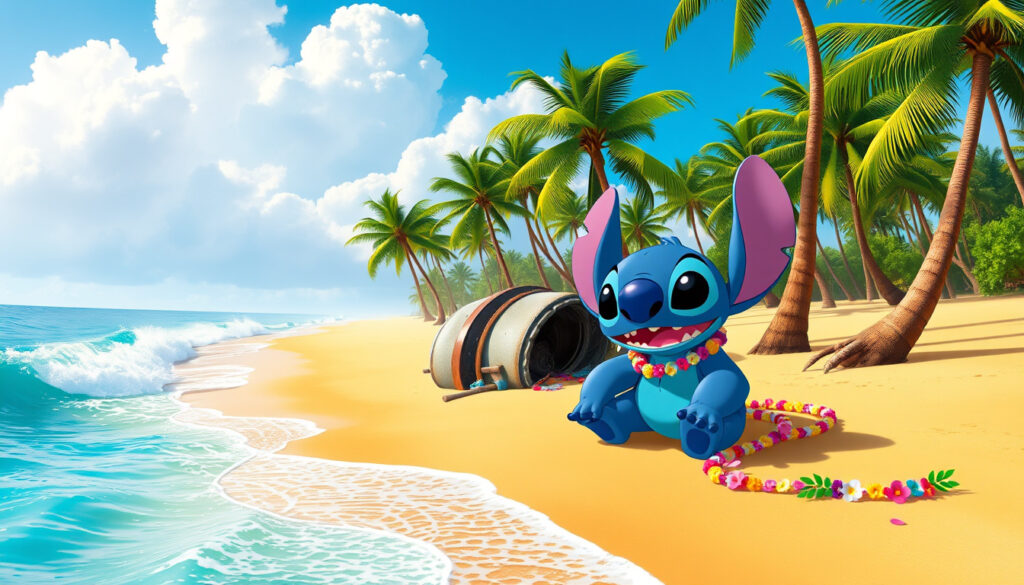
Lilo and Stitch – Franchise Guide to 2002 Film and 2025 Remake
The Lilo & Stitch franchise stands as one of Disney’s most unexpected success stories, born during a difficult period for the animation studio and evolving into a multi-billion-dollar multimedia phenomenon. Centering on the unlikely bond between a Hawaiian orphan and an escaped alien experiment, the franchise has captivated audiences for over two decades with its unique blend of family values, Hawaiian culture, and cosmic adventure. As Disney prepares to release a live-action adaptation in 2025, interest in the franchise continues to grow across multiple generations of fans.
From its modest beginnings as a theatrical release in 2002 to its current status as one of Disney’s top ten highest-grossing franchises, Lilo & Stitch has expanded far beyond its animated roots. The franchise has generated over $7.8 billion in revenue by 2025, including $2.6 billion in retail sales through 2024 and $4 billion in the 2025 fiscal year alone. This financial success reflects a property that has resonated deeply with audiences through films, television series, video games, theme park attractions, and extensive merchandise lines.
The upcoming live-action remake represents the latest chapter in a franchise that has continually reinvented itself while maintaining its core themes of family, acceptance, and the concept of ʻohana. Whether exploring the original 2002 film, the animated series that followed, or the forthcoming live-action adaptation, understanding Lilo & Stitch requires examining both its entertainment legacy and its cultural impact.
What is the new Lilo and Stitch 2025 live-action movie?
A live-action and CGI adaptation of the original Lilo & Stitch film entered production as part of Disney’s broader franchise expansion strategy. This new project reimagines the 2002 story with Stitch rendered as a CGI character alongside live-action human performers, continuing Disney’s established approach of bringing animated classics to real-world settings. The production reflects the franchise’s evolution toward Stitch-centric marketing, a shift that Disney implemented beginning in 2021 to capitalize on the character’s widespread appeal.
Original 2002 Film
The theatrical animated feature that launched the franchise, directed by Chris Sanders and Dean DeBlois, featuring the story of Lilo and her alien companion Stitch.
Live-Action 2025 Remake
A CGI/live-action hybrid adaptation bringing the original story to real-world settings, part of Disney’s franchise expansion initiatives.
Animated Series (2003-2006)
The 65-episode television series continuing the adventures of Lilo, Stitch, and their expanding alien family across two seasons.
Key Franchise Stats
Over $7.8 billion in total revenue by 2025, placing it among Disney’s top ten highest-grossing franchises across multiple media formats.
Production details and creative approach
While specific casting choices and detailed plot information for the 2025 remake remain limited in available sources, the production signals Disney’s commitment to expanding the franchise’s reach. The adaptation follows a pattern established by other Disney remakes, combining practical effects with advanced CGI to recreate characters and settings that audiences first discovered in the animated original. Stitch’s characterization as a CGI creation allows for faithful translation of the character’s expressive abilities and chaotic charm.
Release expectations and market positioning
The live-action remake is positioned within a broader franchise strategy that includes theme park expansions, merchandise initiatives, and continued multimedia presence. Disney’s investment in the adaptation reflects the character’s enduring popularity, particularly among audiences who grew up with the original film and are now introducing their own children to the franchise. The timing of the release aligns with the franchise’s massive revenue generation, as evidenced by the $4 billion in fiscal year 2025 earnings.
- The franchise has generated over $7.8 billion in total revenue by 2025, establishing it as one of Disney’s most profitable properties
- Stitch has emerged as the franchise’s primary mascot, with Disney implementing Stitch-centric marketing starting in 2021
- The live-action adaptation combines CGI character work with live-action performers, following established industry practices
- The remake represents part of Disney’s comprehensive franchise expansion strategy across multiple media platforms
- Theme park attractions like Stitch’s Great Escape have contributed to brand visibility since 2004
- The adaptation targets both nostalgic adult audiences and new generations of young viewers
- Merchandise sales have remained strong, with $2.6 billion in retail revenue through 2024 alone
| Aspect | Original (2002) | Remake (2025) | Animated Series |
|---|---|---|---|
| Director | Chris Sanders, Dean DeBlois | TBA in sources | Various |
| Release Date | June 21, 2002 | 2025 | 2003–2006 |
| Format | Theatrical Animation | Live-Action/CGI Hybrid | Television Series |
| Runtime | Approximately 85 minutes | TBA | 65 episodes |
| Primary Voice Cast | Chris Sanders, Daveigh Chase, Tia Carrere | TBA | Original cast |
| Box Office Performance | Major theatrical success | TBA | N/A (television) |
What is the original Lilo and Stitch (2002) film?
Lilo & Stitch arrived in theaters on June 21, 2002, during what many consider Disney’s animation downturn period following the successful but costly Renaissance era. The film represented a calculated risk for the studio, featuring unconventional character designs, a darker protagonist in Stitch, and heavy incorporation of Hawaiian culture at a time when animated films typically favored European fairy tale settings. Directed by Chris Sanders and Dean DeBlois, the production drew from their experiences on earlier Disney projects while developing a distinctly Pacific Islander sensibility.
Story overview and narrative structure
The narrative centers on Lilo Pelekai, a lonely seven-year-old Hawaiian girl living on the island of Kauaʻi with her older sister Nani following the death of their parents. Lilo’s life takes a dramatic turn when she adopts what appears to be a blue dog at the local animal shelter, unaware that the creature is actually Experiment 626, a genetically engineered being created by the villainous Dr. Jumba Jookiba. Stitch, as Lilo names him, was designed for maximum chaos and destruction, but his attempts to cause mayhem repeatedly fail under Lilo’s unconventional training methods.
The plot unfolds against the backdrop of galactic pursuit, as Captain Gantu leads an elite squad tasked with recapturing the escaped experiment. Meanwhile, Nani struggles to maintain employment and custody of Lilo amid mounting pressures, creating additional tension that requires Stitch’s eventual intervention to resolve. The film’s structure weaves together family drama, science fiction elements, and Hawaiian cultural touches, including hula dance sequences, Elvis Presley music, and photography motifs that reflect Lilo’s eccentric interests in horror films, science fiction, and capturing tourist photographs.
Key themes and cultural significance
The concept of ʻohana, the Hawaiian word for family, serves as the franchise’s thematic foundation. Unlike traditional Disney protagonists, Stitch cannot be domesticated through conventional means; his transformation comes only through genuine love and acceptance within a family unit. This message resonated powerfully at a time when Disney faced criticism for homogenizing its content, and the film’s success demonstrated audience appetite for diverse cultural representations in major studio releases.
The film’s incorporation of Hawaiian culture marked a significant departure from Disney’s European-focused storytelling norms. Authentic elements including language, music, and cultural practices were woven throughout the narrative, contributing to the film’s distinctive identity and critical appreciation for its respectful representation.
Reception and legacy
Lilo & Stitch achieved both critical acclaim and commercial success, revitalizing Disney’s animation department during a challenging period and demonstrating that audiences would embrace non-traditional animated features. The film’s performance helped establish the franchise’s viability across multiple media formats, leading directly to the development of television series, direct-to-video sequels, video games, and the extensive merchandise lines that continue today. The original film’s influence extends beyond its immediate financial returns, having shaped how Disney approaches cultural representation in animation and established a template for franchise expansion that the studio continues to follow.
Who are the main characters in Lilo and Stitch?
The Lilo & Stitch franchise features a diverse ensemble of characters spanning multiple species, worlds, and cultural backgrounds. While the core relationship between Lilo and Stitch drives the franchise’s emotional core, the supporting cast provides essential narrative elements, comedic relief, and thematic depth that have contributed to the property’s lasting appeal.
Lilo Pelekai
Lilo Pelekai serves as the franchise’s human protagonist, a young Hawaiian girl whose distinctive personality combines innocence with eccentricity. Her interests span hula dancing, surfing, horror films, science fiction literature, and photographing tourists at local beaches. Orphaned at a young age following her parents’ death in an automobile accident, Lilo lives with her older sister Nani, who serves as her legal guardian and primary caretaker. Lilo’s character defies typical Disney protagonist conventions, displaying behavioral challenges that the narrative frames as expressions of grief rather than character flaws requiring correction.
Stitch (Experiment 626)
Stitch, designated Experiment 626, represents the franchise’s central non-human character and has evolved into its primary mascot. Created by Dr. Jumba Jookiba as a weapon designed for destruction and mayhem, Stitch possesses superhuman strength, intelligence, and agility alongside a compulsive tendency toward chaos. His physical appearance resembles a blue koala-like creature with distinctive生理 features including expressive ears and a forked tail. Following his escape from galactic custody and subsequent adoption by Lilo, Stitch undergoes gradual moral development, learning family values and emotional attachment despite his original programming.
Nani Pelekai
Nani Pelekai functions as Lilo’s guardian sister, a nineteen-year-old woman shouldering adult responsibilities including employment and family care following her parents’ deaths. The character embodies the strain faced by young caregivers, working multiple jobs while attempting to maintain a stable home environment for her younger sister. Nani’s relationship with Lilo reflects realistic sibling dynamics complicated by the pressures of premature adulthood, providing essential emotional grounding for the franchise’s family themes.
Nani’s characterization represents an important departure from typical Disney guardian figures, showing realistic vulnerability and strength rather than serving as a purely supportive secondary character. Her struggles and eventual triumph resonate with audiences facing similar real-world pressures.
Captain Gantu
Captain Gantu operates initially as the franchise’s primary antagonist among the galactic characters, serving as the massive one-eyed captain of an elite pursuit squad tasked with recapturing escaped experiments. His characterization evolves throughout the franchise, with later appearances showing increasing complexity in his motivations and eventual alliance with the protagonists. Gantu’s release of Dr. Hämsterviel in the series finale Leroy & Stitch marks a significant turning point in his narrative arc, demonstrating capacity for moral reconsideration that distinguishes him from purely villainous figures.
Dr. Jumba Jookiba and supporting alien characters
Dr. Jumba Jookiba, the four-eyed mad scientist responsible for creating Stitch and 624 additional experiments, provides essential backstory and ongoing narrative complications throughout the franchise. His scientific expertise establishes the mythology surrounding the experiments while his eccentric personality generates comedic situations. Agent Pleakley, Jumba’s fellow alien agent, offers contrasting characteristics including sensitivity, fashion interest, and eventual integration into the human household, expanding the franchise’s ensemble while reinforcing themes of acceptance and unconventional family formation.
What is Lilo and Stitch: The Series?
Lilo & Stitch: The Series represents the franchise’s most substantial television expansion, comprising 65 episodes across two seasons that aired from 2003 to 2006 on Disney Channel and ABC. The series emerged directly from the 2003 direct-to-video feature Stitch! The Movie, which introduced the concept of Jumba’s remaining 623 experiments scattered across Earth following Stitch’s capture, establishing premise and character dynamics that the television series would explore extensively.
Overview and episode structure
The series follows Lilo and her extended household, including Stitch, Nani, Jumba, and Pleakley, as they locate and rehabilitate Jumba’s various experiments. Each episode typically centers on a specific experiment with unique abilities and personality traits, with the protagonists working to either capture the creature, address problems it has caused, or relocate it to appropriate circumstances. This episodic structure allowed for creative variety while maintaining consistent character dynamics and thematic elements focused on family acceptance and belonging.
The show maintained substantial continuity with the original film, referencing events while introducing new elements that expanded the franchise’s mythology. Supporting characters from the film appeared regularly, with Gantu’s pursuit duties providing ongoing conflict that occasionally yielded unexpected character development. The series also explored the experiments themselves in greater depth, establishing individual personalities and backstories for creatures that might otherwise function as interchangeable obstacles.
The original animated series (2002-2006) represents the established Western continuity for the franchise. East Asian spin-offs, including the anime series Stitch!, operate within separate continuities and should not be conflated with the core timeline.
Connection to the original film and franchise expansion
The series deepened the franchise’s exploration of the ʻohana concept by introducing experiments that became categorized as Stitch’s “cousins” or extended alien family. This expansion reinforced thematic elements while providing numerous opportunities for character comedy and adventure. The direct-to-video sequels Lilo & Stitch 2: Stitch Has a Glitch (2005) and Leroy & Stitch (2006) maintained continuity with the series while providing narrative closure for the original animated era.
The 2006 series finale Leroy & Stitch brought the original storyline to completion, with Dr. Hämsterviel and Gantu creating Leroy clones of all 624 experiments for a climactic confrontation. The resolution saw all experiments uniting against the Leroys, culminating in a victory that reinforced the franchise’s core message about family and collective action. This conclusion established a definitive endpoint for the original continuity before the franchise transitioned to Japanese markets with the Stitch! anime series.
Lilo & Stitch franchise timeline
The Lilo & Stitch franchise spans over two decades of continuous content releases, theme park developments, and multimedia expansions. Understanding the chronological progression reveals how the franchise evolved from a single theatrical feature to a global media property with diverse content across multiple formats and regional markets.
- June 21, 2002 – Lilo & Stitch theatrical release marks the franchise launch, directed by Chris Sanders and Dean DeBlois, establishing core characters and themes.
- 2003 – Stitch! The Movie direct-to-video release introduces the concept of Jumba’s 623 other experiments, setting up premise for television series.
- 2003–2006 – Lilo & Stitch: The Series airs 65 episodes across two seasons on Disney Channel and ABC, expanding franchise mythology.
- 2005 – Lilo & Stitch 2: Stitch Has a Glitch direct-to-video feature explores Stitch’s malfunction and Lilo’s hula competition.
- 2006 – Leroy & Stitch provides grand finale for original animated era, uniting all experiments against Leroy clones.
- 2008–2015 – Stitch! anime series airs in Japan with new protagonist Yuna Kamihara, shifting franchise focus toward Asian markets.
- 2004 – Stitch’s Great Escape opens at Walt Disney World, introducing theme park attraction featuring the character.
- 2024 – Lilo & Stitch comic series concludes with final issue, featuring adventures across eight published issues.
- 2025 – Live-action/CGI adaptation enters production as part of Disney’s franchise expansion strategy.
What we know and what remains unclear about the Lilo & Stitch franchise
As with any active franchise undergoing development, certain aspects remain firmly established while others await confirmation through official announcements or theatrical release. Understanding the distinction between confirmed information and speculation helps readers navigate the current landscape of Lilo & Stitch content.
| Established Information | Remaining Unclear |
|---|---|
| Live-action adaptation is in active production for 2025 release | Specific cast members have not been officially confirmed |
| Stitch will be rendered as a CGI character | Exact plot deviations from original 2002 story |
| Film is part of comprehensive franchise expansion strategy | Precise theatrical or streaming release date within 2025 |
| Franchise has generated over $7.8 billion in total revenue | Connection to animated series continuity in remake |
| Disney’s Stitch-centric marketing began in 2021 | Specific runtime and production budget figures |
| The 2002 original film revitalization impact on Disney animation | Sequel plans or franchise extension intentions |
The cultural significance of Lilo & Stitch
The Lilo & Stitch franchise occupies a unique position within Disney’s catalog, representing one of the studio’s most successful departures from European fairy tale conventions. The franchise’s integration of Hawaiian culture, language, music, and values into mainstream American animation marked a significant milestone in representation, demonstrating that audiences would embrace culturally specific content when presented with authenticity and respect.
The concept of ʻohana as the franchise’s central theme resonated particularly strongly because it offered an alternative to traditional Disney messaging. Rather than emphasizing romantic love or individual achievement, Lilo & Stitch prioritized the bonds of chosen family, the acceptance of unconventional individuals, and the importance of unconditional support. These themes proved adaptable across multiple formats, from theatrical features to television series to theme park attractions.
The franchise’s commercial success validated Disney’s willingness to take creative risks during a challenging period for animation. The $7.8 billion in franchise revenue by 2025 represents accumulated success across theatrical releases, direct-to-video products, television programming, video games, theme park attractions, and merchandise. This financial performance established templates for franchise management that Disney continues to apply to other properties, as documented by industry analyses.
Sources and expert perspectives on Lilo & Stitch
Documentation of the Lilo & Stitch franchise draws from multiple authoritative sources including official Disney materials, industry tracking services, and established entertainment references. The following perspectives inform this analysis of the franchise’s development, reception, and current status.
The Lilo & Stitch franchise emerged as one of Disney’s most significant creative and commercial recoveries following the animation downturn of the early 2000s, generating substantial revenue while pioneering cultural representation approaches that continue to influence the industry.
Industry tracking data confirms the franchise’s sustained commercial performance, with retail merchandise sales through 2024 reaching $2.6 billion and 2025 fiscal year earnings of $4 billion representing franchise record performance. These figures reflect ongoing audience engagement across multiple generations and media formats.
The franchise’s evolution from single theatrical feature to global media property demonstrates the viability of family-centered, culturally specific storytelling within mainstream commercial animation, establishing precedents for subsequent Disney franchise developments.
Final thoughts on the Lilo & Stitch franchise
The Lilo & Stitch franchise exemplifies how authentic storytelling combined with commercial ambition can generate both critical acclaim and substantial financial returns. From its origins during Disney’s animation challenges to its current status as a multi-billion-dollar property, the franchise has consistently prioritized themes of family, acceptance, and cultural authenticity over conventional animated film formulas.
The upcoming live-action adaptation represents the franchise’s latest evolution, bringing beloved characters to new audiences while serving nostalgic viewers who discovered the original film over two decades ago. As Disney continues expanding the property across theme parks, merchandise, and multimedia platforms, the core message of ʻohana remains unchanged, demonstrating that the franchise’s enduring appeal rests not on special effects or marketing strategies but on genuinely resonant human themes.
For audiences exploring the franchise for the first time or revisiting familiar content, the Lilo & Stitch property offers distinctive entertainment combining Hawaiian cultural elements, science fiction adventure, and timeless family values. The original 2002 film and subsequent animated series provide complete narratives that function independently while contributing to a larger interconnected mythology.
Frequently Asked Questions about Lilo & Stitch
What is the plot of the original Lilo & Stitch movie?
The 2002 film follows Lilo Pelekai, a lonely Hawaiian girl who adopts an alien experiment called Stitch, unaware he was designed for destruction. Through her love, Stitch learns family values while galactic forces pursue him.
How many episodes does Lilo & Stitch: The Series have?
The animated series contains 65 episodes across two seasons, airing from 2003 to 2006 on Disney Channel and ABC.
Where can I watch Lilo & Stitch content?
Streaming availability varies by region. Disney+ typically offers access to animated series and films, though specific titles may rotate. Checking official Disney streaming platforms provides current availability information.
What experiments appear in the Lilo & Stitch series?
Jumba created 624 genetic experiments (plus Leroy), each with unique abilities. The series features numerous experiments rehabilitated by Lilo and Stitch, including Reuben, Sparky, and many others designed for various chaotic purposes.
Who voiced Stitch in the original film?
Chris Sanders provided both the voice and character design for Stitch in the original 2002 film, also serving as co-director alongside Dean DeBlois.
What is the release date for the 2025 live-action remake?
The live-action adaptation is confirmed for 2025 release, though specific theatrical or streaming dates within the year have not been officially announced as of current available sources.
What is the meaning of ʻohana in the franchise?
ʻOhana is a Hawaiian term meaning family in the extended sense, encompassing not just immediate relatives but all those who belong together through bonds of love, acceptance, and mutual commitment. The concept serves as the franchise’s central theme.
More related posts
 Dept of Transport – Responsibilities, Agencies, Leadership
 Toowoomba Rugby League 2026: Results, Fixtures & Schedule
 Best Thriller Movies: Top 10, Greatest Films & Streaming Picks
 Alexandra Grant: Age, Art, and Relationship with Keanu Reeves
 Allianz Online Claim – Step-by-Step Filing Guide
 Palace Cinemas Perth: Showtimes, Platinum, Policies & History
 Brandon Smith charges: What happened to the Rabbitohs player
 Kmart Flannelette Sheets: Sizes, Reviews & Care Guide
