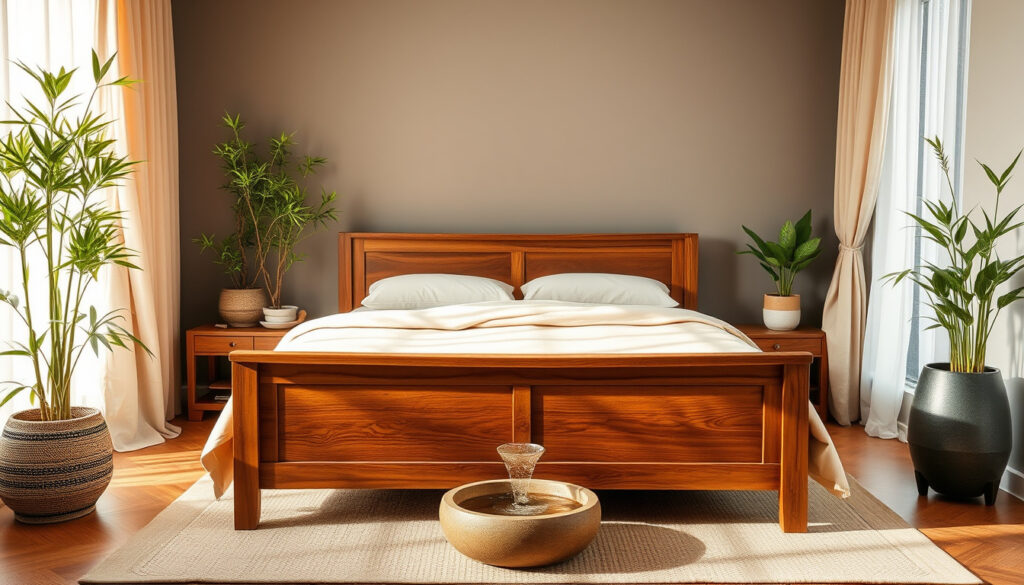
Feng Shui Bedroom: Rules, Layout & Bed Placement Guide
Most people spend more time choosing a bed frame than thinking about where to put it. But Feng Shui practitioners argue the placement matters more than the furniture itself — specifically, the bed needs to sit in what’s called the “command position,” allowing you to see the bedroom door without being directly in its line. According to the International Feng Shui Guild, this positioning creates a sense of security that supports restful sleep (Homes & Gardens). Here’s what you need to know to arrange your bedroom for better energy flow.
Command Position: See door from bed · Best Colors: Beiges, creams, earthy tones · Mirror Rule: Avoid facing bed · Bed Facing: Not door or window · Death Position: Feet toward door
Quick snapshot
- Command position is the primary bed placement rule (Stearns & Foster)
- Never place mirrors facing the bed (Rossetti Art)
- Precise head direction depends on birth details and individual chart
- Regional variations may affect interpretation of compass directions
- Core rules trace to ancient China (Moonchild Sleep)
- 2026 updates include mirror placement refinements (Moonchild Sleep)
- Southern Hemisphere practitioners should flip the Bagua map
- Vastu integration offers additional directional frameworks
Key principles from Feng Shui experts outline what to prioritize and what to avoid for optimal bedroom energy.
| Principle | Rule | Source |
|---|---|---|
| Command Position | View door from bed | Stearns & Foster |
| Prohibited | Bed facing door | Homes & Gardens |
| Colors | Beiges, creams | Anne de Solène |
| Mirrors | Not opposite bed | Moonchild Sleep |
What are the Feng Shui rules for a bedroom?
The foundational rule in Feng Shui bedroom design centers on the command position — placing the bed so you can see the bedroom door from the bed, but not directly in line with it. This diagonal placement creates a sense of security and stability. “First and foremost, you need to feel secure in the bedroom and this means positioning the bed in what’s known as the ‘command position,'” according to the International Feng Shui Guild member quoted by Homes & Gardens (home design publication).
Bed placement affects sleep quality perception more than furniture cost does — and it costs nothing to reposition your bed against a different wall.
Command position basics
The commanding position means your head points toward a solid wall rather than the door, with a clear sightline to the entrance. Stearns & Foster (mattress manufacturer) confirms this allows you to observe who enters without feeling vulnerable. The bed should never have its foot directly across from the doorway — that alignment drains energy, according to practitioners.
Color recommendations
Earth tones like beiges, creams, and soft whites dominate Feng Shui bedroom palettes. Anne de Solène (bedding brand) notes these neutrals create calm environments that support rest. Cooler palettes work better in warm climates, while warmer earth tones suit temperate zones.
General dos and don’ts
- Use two matching bedside tables for balance and unity
- Include matching lamps on both sides
- Keep surfaces clear and clutter-free
- Choose natural materials over synthetic
What is the best direction for my bed to face?
Head direction in Feng Shui depends primarily on room layout rather than compass orientation alone. While traditional texts recommend facing south for restorative sleep — a principle shared with Vastu Shastra — the command position takes precedence. If aligning your head south requires placing the bed where you cannot see the bedroom door, practitioners advise prioritizing the command position first.
Head direction guidelines
Anne de Solène (bedding brand) explains that facing south is traditionally recommended in both Feng Shui and Vastu for restorative sleep. The southeast direction offers an alternative for those whose birth charts suggest it. However, these directional preferences remain secondary to command position placement.
Avoiding poor positions
The “coffin position” — where the foot of the bed points directly at the bedroom door — should be avoided at all costs. “This is known as the ‘corpse’ or ‘coffin’ position and it’s said to drain your energy away as you sleep,” according to Homes & Gardens. This placement allegedly creates passive energy drainage during rest.
Northern Hemisphere practitioners should note that directional guidelines may shift for Southern Hemisphere residents — Feng Shui consultant Julie Khuu discusses how the Bagua map orientation adjusts for those living south of the equator (Julie Khuu YouTube).
Should your bed face the window or door?
Neither the door nor the window should directly face the foot of your bed. The command position allows you to see the entrance from your head position while the bed sits at an angle to it — never directly aligned. Zinus (furniture brand) explicitly warns never to align the foot of the bed directly with the doorway.
Window facing risks
Windows represent active energy entry points in Feng Shui. Homes & Gardens (home design publication) recommends placing the bed against a solid wall and avoiding positioning it under a window. The energy flowing through windows can create instability during sleep. Heavy curtains can mitigate this if architectural constraints prevent relocating the bed.
Door facing issues
Direct alignment with the door — the coffin position — allegedly allows energy to drain away during sleep. Beyond the directional concern, being directly in the doorway’s line creates psychological vulnerability, which contradicts the security Feng Shui seeks to establish in the bedroom.
Why no mirrors in bedroom Feng Shui?
Mirrors multiply energy in Feng Shui, which sounds beneficial until you consider what happens when that energy reflects your sleeping body. “The core Feng Shui rule remains unchanged: never place a mirror where it reflects your bed while you sleep,” according to Moonchild Sleep (sleep wellness publication). This multiplication creates restlessness and symbolically invites third-party energy into relationships.
TVs function as mirrors in Feng Shui — their screens reflect similarly to glass. If you have a television in the bedroom, enclose it or cover it when sleeping to prevent the same energy amplification problem.
Mirror energy effects
Rossetti Art (design publication) explains that mirrors facing the bed create excessive energy and a sense of another presence in the room. This disturbs sleep quality and may affect relationships by symbolically introducing “third party” energy. The bouncing effect activates energy rather than allowing it to settle during rest.
Safe placements
- Side walls perpendicular to the bed
- Inside closets when doors can close
- Reflecting windows rather than the bed
- Above dressers away from the sleep area
City Mattress (sleep retailer) confirms that mirrors should be on perpendicular walls when the command position is established. If mirror placement creates reflection problems, covering it during sleep hours offers a practical compromise.
Where not to put bed feng shui?
Beyond the command position and coffin alignment, several specific locations create problematic energy for sleep. Homes & Gardens (home design publication) lists beam placement, shared walls with kitchens or bathrooms, and window positions as common pitfalls.
Death position details
The “coffin position” or “death position” refers to the foot of the bed aligned directly with the bedroom door. Zinus (furniture brand) confirms this alignment should be avoided at all costs. The energy allegedly drains away through the doorway, leaving the sleeper depleted by morning.
Other no-go spots
- Under ceiling beams — creates oppressive energy above the sleeper
- Directly in front of windows — unstable energy flow
- Against shared walls with kitchens — active fire energy interferes with rest
- Against walls adjoining bathrooms — water element creates moisture-related energy concerns
Wehomz Furn (furniture brand) adds that mirrors facing the bedroom door bounce chi out before it can benefit the space. When room constraints prevent ideal placement, use a tall, solid headboard for support and keep nightstands with drawers to maintain clear surfaces.
Headboard materials and nightstands
Homes & Gardens recommends choosing tall, solid headboards that provide stability and support. Matching nightstands on both sides with lamps create visual harmony. Drawers in nightstands allow storage without cluttering surfaces — clear nightstand tops maintain adaptability for changing needs.
Feng Shui vs. Vastu: Key Differences
While both systems guide bedroom placement, Feng Shui and Vastu Shastra originate from different traditions and emphasize distinct priorities. Tomorrow Sleep (sleep resource) explains that Feng Shui prioritizes the commanding position, while Vastu prefers the southwest corner for bed placement with head direction toward the south, southwest, or west.
Key distinctions between these ancient directional systems affect how practitioners arrange sleeping spaces.
| Aspect | Feng Shui | Vastu Shastra |
|---|---|---|
| Primary bed position | Command position facing door diagonally | Southwest corner of room |
| Preferred head direction | South for restorative sleep | South, southwest, or west |
| Mirror placement | Avoid facing bed; side walls acceptable | North or east walls only |
| Regional origin | Ancient China | Ancient India |
Regional Variations in Practice
Feng Shui practitioners in the Southern Hemisphere must flip their Bagua map orientation, as compass directions affect energy differently when the sun travels north rather than south, according to Julie Khuu (Feng Shui consultant). Vastu mirrors are considered water elements and prefer north or east walls, a specificity not emphasized in Feng Shui interpretation.
How to Arrange a Feng Shui Bedroom: Step by Step
Implementing Feng Shui principles in your bedroom involves a systematic approach. Start with the most critical rule — the commanding position — and work through secondary considerations only after establishing the foundational placement.
- Identify the command position — Test your room’s sightlines by standing at the door and checking which walls allow you to see it while facing away. These walls offer potential commanding positions.
- Place your bed — Position the bed against a solid wall with a clear diagonal view to the bedroom door. Confirm the foot of the bed does not point directly at the entrance.
- Select neutral colors — Choose beiges, creams, or soft earth tones for bedding and walls. Add warmth with wooden furniture and natural textiles.
- Add matching nightstands — Place identical tables on both sides with matching lamps. Clear surfaces daily to maintain clear energy paths.
- Address mirrors — Remove or relocate any mirrors reflecting the bed. Cover television screens when not in use. Keep remaining mirrors on side walls away from sleep sightlines.
For those unable to achieve ideal placement due to room constraints, practitioners suggest using a tall, solid headboard for support and maintaining clear pathways around the bed. Heavy curtains at problematic windows and strategic artwork placement can also mitigate challenging layouts.
Homes & Gardens
“First and foremost, you need to feel secure in the bedroom and this means positioning the bed in what’s known as the ‘command position.'”
Moonchild Sleep
“The core Feng Shui rule remains unchanged: never place a mirror where it reflects your bed while you sleep.”
The 5 Core Feng Shui Bedroom Rules
The essential Feng Shui bedroom principles reduce to five actionable rules that even skeptics can implement. These guidelines create positive energy flow without requiring deep study of directional charts or elemental theory.
- Command position first — Ensure you can see your bedroom door from bed without being directly in its line. Diagonal placement works when direct positioning is impossible.
- Mirror awareness — Verify no mirrors reflect your bed. If they do, reposition, cover during sleep, or replace with artwork.
- Earthy color palette — Choose beiges, creams, and soft neutrals over bold colors. The goal is calming energy, not stimulating decor.
- Head direction consideration — Facing south provides optimal restorative energy, but command position takes priority over compass orientation.
- Clear energy pathways — Keep the space around your bed free of clutter. Ensure both sides of the bed have equal access and matching nightstands.
If you share your bed with a partner, both command position and head direction become harder to optimize — the best compromise prioritizes the primary sleeper’s needs while maintaining diagonal door visibility.
For apartment dwellers with fixed layouts, the Feng Shui principles offer guidance rather than strict requirements. Small adjustments — relocating a mirror, adding matching lamps, clearing nightstand surfaces — can shift energy flow without major furniture rearrangement.
Related reading: Bedroom sheets guide
These core principles echo the dream bedroom Feng Shui tips from Scandinavian experts, which highlight layouts fostering restful sleep and positive chi flow.
Frequently asked questions
What colors are best for Feng Shui bedroom?
Beige, cream, soft white, and other neutral earth tones create the most supportive energy for sleep. Cooler palettes work in warm climates; warmer earth tones suit temperate regions. Avoid bold reds and bright blacks, which stimulate rather than calm.
How to create positive energy in Feng Shui bedroom?
Clear clutter daily, maintain clear pathways around the bed, use natural materials (wood, cotton, linen), add plants if possible, and ensure balanced lighting with matching lamps on both nightstands. The command position placement also significantly affects energy quality.
Can you have a TV in Feng Shui bedroom?
TVs function as mirrors in Feng Shui interpretation. If you keep one in the bedroom, enclose it in a cabinet or cover it when sleeping to prevent energy amplification that disrupts rest.
What is Vastu sleeping direction?
Vastu recommends placing the bed in the southwest corner of the room with the head pointing south, southwest, or west. Unlike Feng Shui’s command position priority, Vastu emphasizes directional alignment more heavily.
Feng Shui bedroom layout for small rooms?
In compact spaces, prioritize the command position above all else. Choose a low-profile bed to reduce visual weight, use mirrors on side walls to expand the space, and maintain the earthy neutral color palette to keep energy calm despite limited square footage.
Does Feng Shui bedroom improve sleep?
While scientific validation remains limited, practitioners report improved rest quality after implementing command position placement and removing bed-facing mirrors. The psychological security of seeing your door may contribute to better sleep regardless of energy philosophy.
Safe headboard materials Feng Shui?
Solid wood headboards rank highest in Feng Shui interpretation. Avoid metal frames that create cold energy or decorative headboards with sharp angles. A tall, solid headboard provides psychological support and stability according to practitioners.
For renters or those with fixed furniture placement, Feng Shui offers actionable adjustments within constraints. Even small changes — repositioning a mirror, adding matching lamps, clearing a nightstand — can shift energy perception without major rearrangement. Renters who implement the commanding position — seeing the door from bed without directly facing it — address the core concern that practitioners believe affects sleep quality and relationship harmony.
More related posts
 Ahaan Panday: Age, Family, Debut Movie, and Relationship Rumors
 Ricky Hatton Death: Inquest, Cause, Will & Family
 Car Battery Charger Guide: Charge a Dead Battery & Avoid Mistakes
 Today’s Newspaper Ireland: Headlines & Breaking News
 Alexander Bublik: Wife, Nationality Change, Sock, Ranking & Life
 Alpha Medical Clinic – Aesthetic Treatments in Longford
 Mary Shelley: Tragedies, Controversies, and Legacy
 Eija Skarsgård: Age, Siblings, Movies, and Family Facts | Guide
