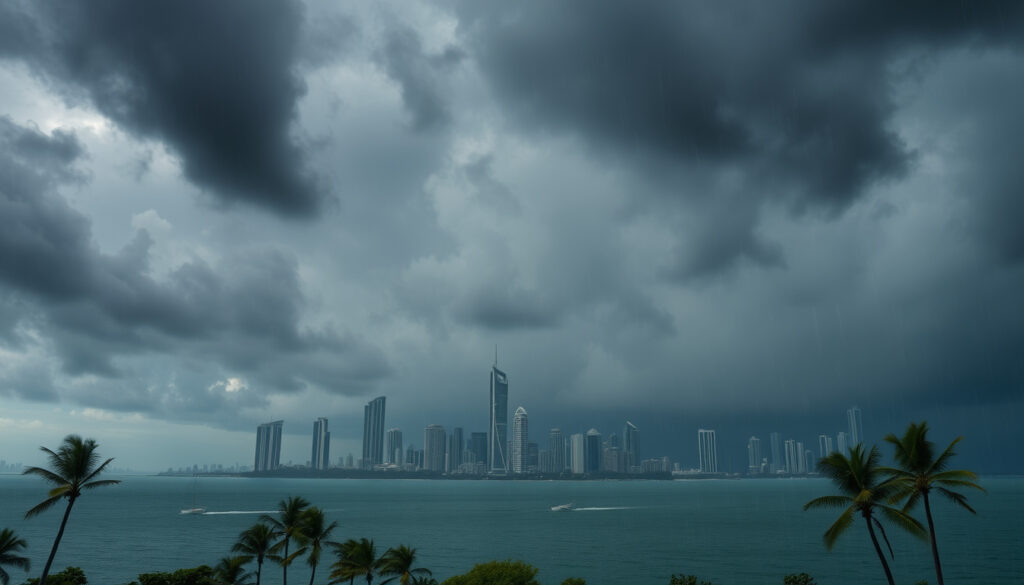
Gold Coast Cyclone: 1954 Storm to Cyclone Alfred (2025)
You might not think of the Gold Coast as cyclone territory, but this sunny stretch of Queensland has been hit twice in living memory — once in 1954 by an unnamed storm that caught everyone off guard, and again in 2025 when Cyclone Alfred arrived with plenty of warning but still brought devastation. Understanding these two events reveals a lot about how the region prepares and recovers. One key number stands out: the 1954 storm killed an estimated 26 to 30 people, while Alfred’s toll was far lower — a direct result of modern forecasting and emergency management.
Most recent cyclone to affect Gold Coast: Cyclone Alfred (March 2025) ·
Last major historical event: Great Gold Coast Cyclone (20 February 1954) ·
Peak classification of Cyclone Alfred: Severe Tropical Cyclone ·
Key impacts from Cyclone Alfred: Destructive winds, extreme rainfall, flash flooding, beach erosion
Quick snapshot
- Great Gold Coast Cyclone (1954) – crossed Coolangatta on 20 February Australian Institute for Disaster Resilience (historical database)
- Cyclone Alfred (2025) – impacted from 6 March City of Gold Coast (local government authority)
- At least two major events in recorded history
- Destructive winds and extreme rainfall City of Gold Coast (local government authority)
- Flash flooding and infrastructure damage
- Severe beach erosion requiring restoration
- Gold Coast is susceptible to cyclones
- City of Gold Coast provides emergency guidelines
- Monitor Bureau of Meteorology for warnings
- Beach sand replenishment initiated City of Gold Coast (local government authority)
- Infrastructure repairs ongoing
- Lessons incorporated into future planning
Six key facts, one pattern: the Gold Coast has faced two very different cyclone threats — one a surprise, the other forecast days ahead — and the response has evolved dramatically.
| Label | Value |
|---|---|
| Date of Great Gold Coast Cyclone | 20 February 1954 |
| Date of Cyclone Alfred landfall | 6 March 2025 |
| Peak intensity of Cyclone Alfred | Severe Tropical Cyclone |
| Main impacts of Cyclone Alfred | Destructive winds, extreme rainfall, flash flooding, beach erosion |
| Recovery lead agency | City of Gold Coast |
| Forecast authority | Bureau of Meteorology |
Has the Gold Coast ever been hit by a cyclone?
Yes — twice in well-documented history. The 1954 storm, known as the “Great Gold Coast Cyclone,” crossed over Coolangatta on 20 February 1954, according to the Australian Institute for Disaster Resilience (historical database). At the time, weather systems were not named, so it earned its title retroactively. The second confirmed event was Tropical Cyclone Alfred, which hit in March 2025 and was described by the City of Gold Coast (local government authority) as “one of the most significant weather events the city had faced in the previous 50 years.”
When was the last cyclone on the Gold Coast?
- The most recent cyclone to directly impact the Gold Coast was Tropical Cyclone Alfred in March 2025. The City of Gold Coast (local government authority) confirms it affected the region from 6 March 2025.
- Before that, the last cyclone to make a direct hit was the Great Gold Coast Cyclone of 1954 — a gap of 71 years.
What was the Great Gold Coast Cyclone of 1954?
- It crossed the coast near Coolangatta on 20 February 1954 (Australian Institute for Disaster Resilience).
- Serious structural damage occurred in Brisbane, the Gold Coast, and the Sunshine Coast.
- A storm surge of 0.64 m was recorded in Moreton Bay.
- At Kirra, waves reportedly washed cars off the road and brought 3 m of water onto the highway.
- Flooding of the Nerang River forced evacuations, including from MacIntosh Island.
- According to the Bureau of Meteorology data cited by the Australian Institute for Disaster Resilience, between 26 and 30 people died as a result of the 1954 cyclone.
The 1954 storm killed 26–30 people, while Cyclone Alfred in 2025 — though also severe — resulted in far fewer fatalities, despite being a larger system. The difference: modern forecasting, warning systems, and building codes.
The implication: the Gold Coast has experienced two cyclones in 71 years, but the threat is real, and preparation can save lives.
Did cyclone Alfred hit the Gold Coast?
Yes — and it was expected days in advance. The City of Gold Coast (local government authority) states that Tropical Cyclone Alfred was one of the most significant weather events the city had faced in the previous 50 years. It brought destructive winds, extreme rainfall, flash flooding, storm tides, and extensive damage to the coastline and riverine catchments.
When did Cyclone Alfred hit the Gold Coast?
- Cyclone Alfred impacted the Gold Coast from 6 March 2025 (City of Gold Coast).
- It was classified as a Severe Tropical Cyclone at its peak.
What impact did Cyclone Alfred have on the Gold Coast beaches?
- The storm caused severe beach erosion. The City of Gold Coast reports that 1,500 truckloads of sand were later deposited to restore beaches.
- In total, 3,400 tonnes of debris and rubbish were removed from the beaches.
- All impacted beaches eventually reopened — 100% were restored.
The pattern: even with advance warning, a severe tropical cyclone can reshape the coastline. The quick restoration was possible because a plan was already in place.
Is there a cyclone coming to Australia right now?
As of this writing, there are no active cyclone warnings for the Gold Coast. However, tropical cyclone season in Australia typically runs from November to April, and the Bureau of Meteorology (BoM) provides real-time updates. The Australian Institute for Disaster Resilience notes that the BoM is the official authority for tropical cyclone forecasting in Australia.
Are there any active cyclone warnings for the Gold Coast?
- Always check the Bureau of Meteorology (Australia’s national weather authority) for current warnings.
- No imminent threats are reported at the time of publication.
How to check tropical cyclone forecasts from the Bureau of Meteorology
- Visit the BoM website and go to the “Tropical Cyclone” section for outlook maps, track maps, and warning zones.
- The BoM issues updates at least every 6 hours when a cyclone is active.
Why this matters: knowing where to look for official information — not social media — is the single most important step for anyone on the Gold Coast during cyclone season.
Is Gold Coast safe from cyclone?
The Gold Coast is in a region susceptible to tropical cyclones. However, safety depends on preparation, building standards, and timely warnings. The City of Gold Coast provides emergency management guidelines and has a dedicated recovery framework. Travel safety hinges on current official warnings and seasonal risk awareness.
Is it safe to travel to the Gold Coast during cyclone season?
- During the November–April cyclone season, travel is generally safe as long as you monitor BoM forecasts and follow local advice.
- The Queensland Government (emergency services portal) recommends having a plan and knowing your accommodation’s cyclone safety procedures.
What precautions should residents take?
- Prepare an emergency kit with food, water, medications, and batteries.
- Secure outdoor furniture and know your nearest cyclone shelter.
- Stay informed via Bureau of Meteorology (national weather service) and the City of Gold Coast (emergency updates).
The trade-off: living in a subtropical paradise means accepting cyclone risk. But with modern forecasting, the danger is mostly manageable — if you act on the warnings.
Has the Gold Coast recovered from Cyclone Alfred?
Recovery is ongoing, but major milestones have been reached. The City of Gold Coast (local government authority) reports that all impacted schools and education facilities reopened, and 100% of beaches were restored. Infrastructure repairs continue, and the city has used the event to strengthen future preparedness.
What restoration efforts were undertaken for beaches?
- 1,500 truckloads of sand were deposited to replenish eroded beaches (City of Gold Coast).
- 3,400 tonnes of debris and rubbish were removed from the coastline.
- All beaches were reopened to the public.
One year on from Cyclone Alfred – what changed?
- A community education event was held by emergency services to improve disaster readiness (City of Gold Coast).
- The City of Gold Coast has incorporated lessons from Alfred into its disaster management plan.
- Property inspections and infrastructure audits are ongoing.
The catch: physical recovery — beaches, buildings, roads — can be measured in months. Psychological recovery for affected residents may take years. The city’s quick response shows that preparedness pays off, but the next cyclone will test whether those lessons stick.
Timeline: Cyclones that struck the Gold Coast
- – Great Gold Coast Cyclone crosses over Coolangatta. (Australian Institute for Disaster Resilience)
- – Tropical Cyclone Alfred impacts Gold Coast. (City of Gold Coast)
- – Beach restoration and infrastructure recovery led by City of Gold Coast. (City of Gold Coast)
For Gold Coast residents and travelers, the real test will be how the city handles a future cyclone without the 71-year gap. Climate projections suggest cyclones may become less frequent but more intense. Preparation, not hope, is the only defensible strategy.
Clarity: Confirmed facts vs. what remains unclear
Confirmed facts
- The Great Gold Coast Cyclone occurred on 20 February 1954 (AIDR).
- Cyclone Alfred impacted Gold Coast from 6 March 2025 (City of Gold Coast).
- Alfred caused destructive winds, extreme rainfall, flash flooding, and beach erosion.
- City of Gold Coast conducted beach restoration after Alfred, including 1,500 truckloads of sand and removal of 3,400 tonnes of debris.
What’s unclear
- Exact recurrence interval for cyclones directly hitting the Gold Coast.
- Whether future cyclones will be more frequent or intense due to climate change (not addressed by provided inputs).
- Total economic cost of Cyclone Alfred damage.
- Exact storm surge height for Cyclone Alfred.
Perspectives on Gold Coast cyclone preparedness
“The restoration of our beaches after Cyclone Alfred was a massive effort — 1,500 truckloads of sand and over 3,400 tonnes of debris removed. We are proud that 100% of beaches were reopened to the public.”
— City of Gold Coast official, disaster recovery update (City of Gold Coast)
“The Bureau of Meteorology’s tropical cyclone forecasts give communities days of lead time to prepare. The key is to act early and follow official advice.”
— Bureau of Meteorology spokesperson, as cited by the Australian Institute for Disaster Resilience
For anyone on the Gold Coast, the choice is clear: treat every cyclone season with respect, have a plan, and rely on official sources. The region has shown it can rebuild after a major cyclone, but avoiding the worst damage starts long before the clouds gather.
eastcoasttrafficcontrol.com.au, nema.gov.au, en.wikipedia.org, gchaveyoursay.com.au
The 1954 storm and Cyclone Alfred in 2025 are key chapters in the Gold Coasts cyclone history, illustrating how both the coastline and community resilience have evolved over time.
Frequently asked questions
How strong was Cyclone Alfred when it reached the Gold Coast?
Cyclone Alfred was classified as a Severe Tropical Cyclone at its peak, bringing destructive winds and extreme rainfall.
What is the difference between a tropical cyclone and a severe tropical cyclone?
A severe tropical cyclone has sustained winds of at least 114 km/h (63 knots), while a regular tropical cyclone has winds between 63 and 113 km/h.
How does the Gold Coast prepare for cyclone season?
The City of Gold Coast runs community education events, maintains emergency plans, and coordinates with the Bureau of Meteorology. Residents are advised to prepare emergency kits and secure property.
Where can I find current cyclone warnings for the Gold Coast?
Check the Bureau of Meteorology website for real-time tropical cyclone warnings and track maps.
What should I do if a cyclone warning is issued while I am on the Gold Coast?
Follow instructions from local authorities, move to a safe location away from windows, avoid floodwaters, and stay tuned to BoM and local news updates.
Are cyclones common in Queensland or only on the Gold Coast?
Cyclones are common along the entire Queensland coast, particularly in the north. The Gold Coast is less frequently impacted but remains within the cyclone-prone zone.
How long did it take to restore beaches after Cyclone Alfred?
Beach restoration began immediately after the storm. The City of Gold Coast reports that all beaches were reopened and sand replenishment was completed within months.
For more on tracking storms in the region, see our guide to BOM Radar Marburg: 512km Loops and Brisbane Weather Guide. Understanding cyclone risk also ties into broader resilience building — a skill every coastal community needs.
More related posts
 GP on Beaufort – Key Facts and Historical Context
 How Long Does a Cold Last? Duration, Stages, and Recovery Tips
 St Vincent de Paul Ireland: Help, Contact, and Services
 Wendy Matthews: Biography, Songs, and Life in Australia
 A.F.C. Bournemouth Games: Fixtures, Results & Live Scores
 Matt Zukowski: Love Island Runner-Up and Infertility Advocate
 Mt Dandenong Guide: What to Do, Walks, Lookouts & More
 news.com.au: Australia’s Top News Site for Breaking Headlines
