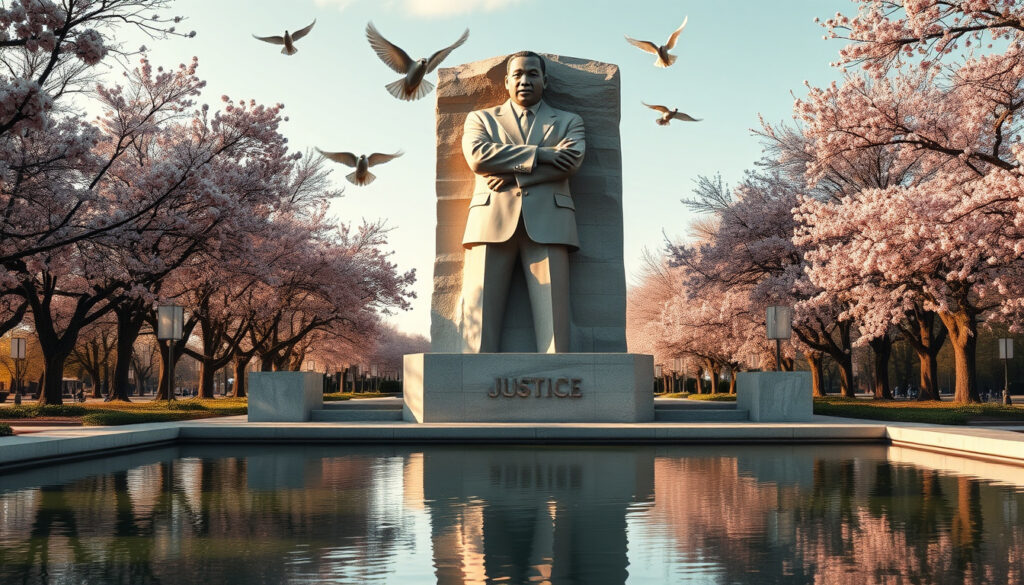
Martin Luther King Jr: Biography, Facts, Assassination & Legacy
Few names in American history still carry the weight of Martin Luther King Jr — but what he actually stood for can get lost in the annual tributes and political speeches. This article separates the man from the myth with a fact‑checked timeline, a look at questions about his views on LGBTQ equality, and an honest assessment of how his message gets used today.
Born: January 15, 1929 ·
Died: April 4, 1968 ·
Age at death: 39 years ·
Nobel Peace Prize: 1964 ·
Notable speech: “I Have a Dream” (1963) ·
Key campaign: Montgomery Bus Boycott (1955–1956)
Quick snapshot
- Baptist minister (Britannica)
- Civil rights leader (Library of Congress)
- Nobel Peace Prize winner (U.S. National Archives)
- Assassinated in 1968 (U.S. National Archives)
- Montgomery Bus Boycott (Library of Congress)
- March on Washington (Library of Congress)
- Civil Rights Act of 1964 (U.S. National Archives)
- Voting Rights Act of 1965 (U.S. National Archives)
- Nonviolence (Britannica)
- Christian love (Britannica)
- Economic justice (U.S. National Archives)
- Racial equality (Library of Congress)
Eight key facts, one pattern: Martin Luther King Jr was shaped by education, faith, and a relentless commitment to nonviolent change.
| Attribute | Detail |
|---|---|
| Full name | Martin Luther King Jr. (born Michael King Jr.) |
| Birth date and place | January 15, 1929, Atlanta, Georgia |
| Death date and place | April 4, 1968, Memphis, Tennessee |
| Education | Morehouse College (BA), Crozer Theological Seminary (BD), Boston University (PhD) |
| Religion | Baptist (ordained minister) |
| Spouse | Coretta Scott King (married 1953) |
| Children | Yolanda, Martin III, Dexter, Bernice |
| Notable awards | Nobel Peace Prize (1964), Presidential Medal of Freedom (1977, posthumous) |
What is Martin Luther King famous for?
Role in the Civil Rights Movement
Martin Luther King Jr. was a Baptist minister and civil rights activist who became the most visible spokesperson for the American civil rights movement. He was elected president of the Montgomery Improvement Association in 1955, after Rosa Parks was arrested for refusing to give up her bus seat (Library of Congress). The Montgomery Bus Boycott lasted 381 days and ended with the U.S. Supreme Court ordering Montgomery to integrate its bus system (Library of Congress).
Nonviolent philosophy and key campaigns
King’s approach was rooted in Christian love and the philosophy of nonviolence, which he first learned about while studying at Crozer Theological Seminary (Britannica). He helped found the Southern Christian Leadership Conference (SCLC) in 1957, serving as its first president (U.S. National Archives). King led the Birmingham campaign in 1963 and was arrested, writing his famous Letter from Birmingham Jail while imprisoned (Library of Congress). He also organized the Selma to Montgomery marches in 1965, which helped secure passage of the Voting Rights Act (U.S. National Archives).
Major speeches and writings
King delivered his “I Have a Dream” speech on August 28, 1963, from the steps of the Lincoln Memorial to a crowd of 250,000 people during the March on Washington for Jobs and Freedom (Library of Congress). The speech remains one of the most recognizable orations in American history, calling for an end to racism and the realization of racial equality.
King’s fame rests on a set of concrete achievements — the Montgomery boycott, the March on Washington, the Nobel Peace Prize — not just eloquence. His legacy was built through organized campaigns that shifted federal law.
Did MLK support LGBTQ?
MLK’s recorded statements on homosexuality
No direct public statements by Martin Luther King Jr. on LGBTQ rights have been found. According to historians, the topic of homosexuality was not a public issue during King’s lifetime in the same way it is today (USA Today). There is no evidence King ever addressed the subject in his speeches, sermons, or writings.
Views of King’s family and associates
Coretta Scott King, MLK’s widow, later expressed support for LGBTQ rights. In 1998, she said, “I still hear people say that I should not be talking about the rights of lesbian and gay people. But I must be true to my commitment to the principles that Martin Luther King Jr. stood for — justice, equality, and freedom for all people” (USA Today). King’s daughter, Bernice King, has also spoken about the need to extend her father’s teachings to the LGBTQ community.
Contemporary debates and historical context
Some scholars argue that King’s philosophy of justice would logically extend to LGBTQ equality, though they note this is an extrapolation rather than a documented position. The debate reflects broader tensions about how historical figures’ legacies are applied to modern social movements.
King’s silence on LGBTQ issues is itself a historical fact. His family’s subsequent advocacy fills that gap, but it cannot be retroactively attributed to King himself without distorting the record.
The trade-off: Using King as a symbol for modern causes requires honesty about what he actually said. His principles of radical inclusion and justice for all are clear. His personal stance on one specific question is not.
How old would MLK be if alive today?
Calculating current age from birth date
Martin Luther King Jr. was born on January 15, 1929 (U.S. National Archives). If alive in 2025, he would be 96 years old. He was assassinated on April 4, 1968 at age 39 (U.S. National Archives).
Hypothetical life expectancy and health
This question is speculative and cannot be answered with certainty. The average life expectancy for Black men in the United States today is around 71 years, but individuals with access to excellent healthcare, as a Nobel laureate and global figure likely would have, can live significantly longer. King’s family history — his father, Martin Luther King Sr., lived to 84 — suggests a potential for longevity.
Impact of assassination on his potential contributions
The question of “what if” is impossible to answer. King’s assassination cut short a life of extraordinary influence at its peak. Had he survived, his later career might have continued focusing on the Poor People’s Campaign, which he was organizing at the time of his death, addressing economic inequality across racial lines.
Why this matters: King’s age at death — 39 — is a stark reminder of the violence that ended his work. The hypothetical question of his current age underscores how much leadership was lost.
What are 5 important facts about Martin Luther King?
Early life and education
- He was born Michael King Jr. and later his father changed both their names to Martin Luther King (USA Today).
- He began attending Morehouse College at age 15 (Britannica).
- He earned a bachelor’s degree in sociology from Morehouse in 1948 (Britannica).
- He earned a Ph.D. in theology from Boston University.
Civil rights leadership
King was elected president of the Montgomery Improvement Association in 1955 and led the Montgomery Bus Boycott (Library of Congress). He was arrested over 20 times for his activism, according to the King Center. He won the Nobel Peace Prize in 1964 (U.S. National Archives).
Prison and the Letter from Birmingham Jail
While imprisoned in Birmingham in 1963, King wrote his famous Letter from Birmingham Jail, a defense of nonviolent resistance against segregation (Library of Congress). The letter, addressed to white clergymen who criticized his methods, remains one of the most important documents of the civil rights movement.
Assassination and legacy
King was assassinated on April 4, 1968 at the Lorraine Motel in Memphis, Tennessee (U.S. National Archives). He was shot while standing on the balcony (Britannica).
National holiday
Martin Luther King Jr. Day is a federal US holiday observed on the third Monday of January. The first official observance took place in 1986. The King Center in Atlanta and the Martin Luther King Jr. Memorial in Washington, D.C., serve as permanent tributes.
King was arrested more than 20 times, yet he is remembered primarily as a peaceful leader. His willingness to go to jail was a deliberate strategy — not a mark of failure, but of conviction.
The pattern: Each of these facts reveals a man who combined intellectual preparation with direct action. King was not just a speaker; he was a strategist who understood the power of civil disobedience.
What did Trump say about MLK?
President Trump’s official statements on MLK Day
Donald Trump made remarks praising Martin Luther King Jr. on Martin Luther King Jr. Day during his presidency. His proclamations typically honored King’s legacy while emphasizing themes of unity and law and order. For example, in his 2020 proclamation, Trump called King a “tireless advocate for peaceful change” and said the nation should “honor his memory by fostering a society where every child can grow up in safety and opportunity” (USA Today).
Comparisons between Trump’s rhetoric and MLK’s legacy
Critics have noted that Trump’s statements sometimes conflict with King’s own words. For instance, Trump’s emphasis on “law and order” stood in contrast to King’s critique of systemic injustice in the justice system. Some activists accused Trump of misappropriating King’s message by using it to support policies that King likely would have opposed, such as immigration restrictions and cuts to social programs.
Critiques from civil rights leaders
Civil rights leaders and commentators have pointed out that Trump’s relationship with the Black community was often strained, and that his use of King’s legacy in speeches felt performative to many. The NAACP and other organizations have criticized Trump for what they view as selective and decontextualized use of King’s memory.
The implication: The debate over Trump’s use of MLK’s legacy highlights a broader tension: King’s message is now a political tool, available to leaders across the spectrum. The question is whether the speaker’s actions align with King’s actual commitments.
Timeline
Born January 15 in Atlanta, Georgia. (U.S. National Archives)
Ordained as a Baptist minister. (Britannica)
Leads Montgomery Bus Boycott after Rosa Parks’ arrest. (Library of Congress)
Co-founds the Southern Christian Leadership Conference (SCLC). (U.S. National Archives)
Leads Birmingham campaign; writes Letter from Birmingham Jail; delivers ‘I Have a Dream’ speech during March on Washington. (Library of Congress)
Awarded Nobel Peace Prize; Civil Rights Act becomes law. (U.S. National Archives)
Leads Selma to Montgomery marches; Voting Rights Act passes. (U.S. National Archives)
Assassinated April 4 in Memphis, Tennessee. (U.S. National Archives)
First official observance of Martin Luther King Jr. Day as a federal holiday. (Britannica)
The timeline shows the rapid progression of King’s work from the Montgomery Bus Boycott to his assassination in just 13 years.
Confirmed facts and what remains unclear
Confirmed facts
- MLK was born January 15, 1929. (U.S. National Archives)
- MLK was assassinated April 4, 1968. (U.S. National Archives)
- He advocated nonviolent civil disobedience. (Library of Congress)
- He won the Nobel Peace Prize in 1964. (U.S. National Archives)
- His birthday is observed as a federal holiday. (Britannica)
What’s unclear
- Whether MLK would have supported modern LGBTQ rights movements (no recorded public stance). (USA Today)
- Exact details of what Trump said on every MLK Day (multiple statements over years). (USA Today)
- Whether MLK would have been alive today if not shot (speculative).
- Whether MLK’s economic views align with modern socialism (no direct statement).
- Whether MLK would have survived to old age if not shot (speculative).
The confirmed facts solidly establish King’s historical record, while the unclear areas remind us of the limits of historical knowledge.
Quotes from MLK and his family
“I have a dream that my four little children will one day live in a nation where they will not be judged by the color of their skin but by the content of their character.”
— Martin Luther King Jr., from his ‘I Have a Dream’ speech at the Lincoln Memorial, 1963 (Library of Congress)
“Injustice anywhere is a threat to justice everywhere. We are caught in an inescapable network of mutuality, tied in a single garment of destiny.”
— Martin Luther King Jr., from his ‘Letter from Birmingham Jail’, 1963 (Library of Congress)
“I still hear people say that I should not be talking about the rights of lesbian and gay people. But I must be true to my commitment to the principles that Martin Luther King Jr. stood for — justice, equality, and freedom for all people.”
— Coretta Scott King, statement supporting LGBTQ rights, 1998 (USA Today)
“Dr. King was a tireless advocate for peaceful change, and we honor his memory by fostering a society where every child can grow up in safety and opportunity.”
— President Donald Trump, Proclamation for MLK Day, 2020 (USA Today)
These quotes illustrate the range of voices that claim King’s legacy, from his own words to his family’s extension of his principles.
Summary
Martin Luther King Jr. was a real person with a radical vision — not a static symbol. His legacy is claimed by both activists and politicians, but the facts of his life remain clear: he led a movement that changed American law, and he died for it. For anyone trying to understand modern debates about race, justice, and equality, the choice is to read his actual words and actions, or to let others speak for him.
britannica.com, voanews.com, uh.edu, umu.libguides.com, archives.gov, britannica.com, nationalarchivesstore.org
For a comprehensive overview of his life and impact, readers can explore a detailed biography and legacy that covers his early years, key speeches, and enduring influence.
Frequently asked questions
What was Martin Luther King Jr.’s birth name?
He was born Michael King Jr. His father, a Baptist minister, later changed both their names to Martin Luther King after the Protestant reformer.
Where did Martin Luther King Jr. deliver his ‘I Have a Dream’ speech?
He delivered the speech from the steps of the Lincoln Memorial in Washington, D.C., on August 28, 1963, during the March on Washington for Jobs and Freedom.
How many times was Martin Luther King Jr. arrested?
King was arrested over 20 times for his activism. His most famous arrest was in Birmingham, Alabama, in 1963, where he wrote his Letter from Birmingham Jail.
What is the Martin Luther King Jr. Memorial?
The Martin Luther King Jr. Memorial is a 30-foot granite statue of King located on the National Mall in Washington, D.C. It was dedicated in 2011.
When did Martin Luther King Jr. win the Nobel Peace Prize?
King won the Nobel Peace Prize in 1964 at age 35, making him the youngest male recipient of the award at that time.
What were Martin Luther King Jr.’s last words?
According to witnesses, King’s last words were to musician Ben Branch, asking him to play “Precious Lord, Take My Hand” at a rally that evening. He was shot moments later.
How many children did Martin Luther King Jr. have?
King and his wife Coretta had four children: Yolanda (born 1955), Martin Luther King III (born 1957), Dexter (born 1961), and Bernice (born 1963).
These FAQs address common questions about King’s life and legacy.
Related reading
- Ruth Bader Ginsburg: Her Life, Legacy, and Key Facts — Another iconic American civil rights figure who fought for equality and justice.
- Woody Guthrie: Biography, Illness, Famous Song & Legacy — A folk singer and social justice activist whose protest anthems influenced the civil rights movement.
More related posts
 Rick Harrison 2025: Net Worth, Wife, Court Case, and Death Rumors
 Qantas Premier Platinum – Benefits, Fees and Bonus Points
 How to Deep Clean a Kitchen: Pro Steps for Filthy Spaces
 Manute Bol: Height, Syndrome, and Son Bol Bol
 Ray Hadley: Retirement, Return Speculation, Personal Life
 Ralph Macchio: Net Worth, Age, Ethnicity & Youthful Look
 Brittany Higgins: Bankruptcy, Baby, and Legal Battles
 La Roche-Posay B5: Uses, Benefits, Reviews & Comparisons
