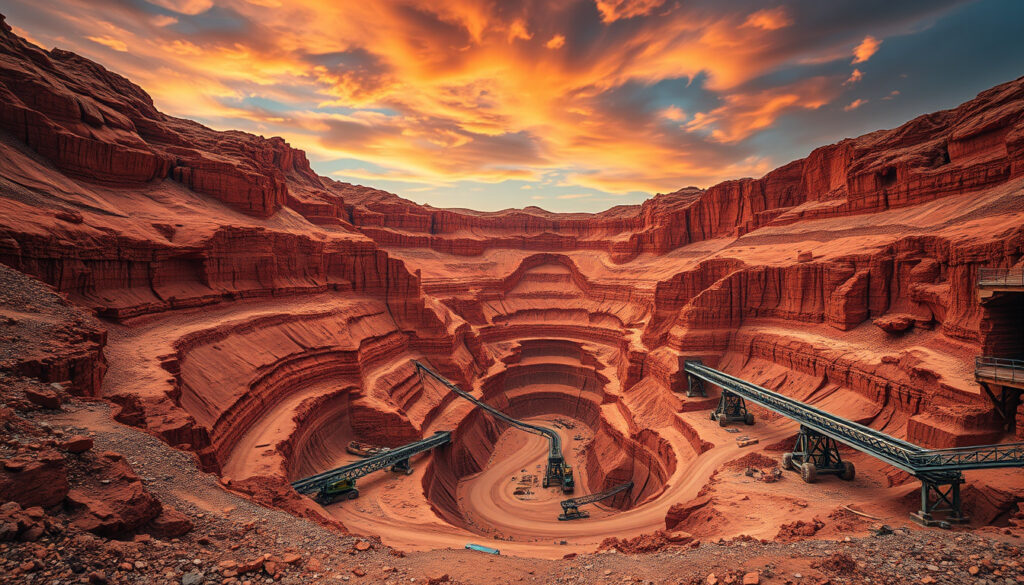
Rio Tinto: British-Australian Giant – Ownership & Profile
When you think of the world’s biggest mining companies, two names usually come to mind: BHP and Rio Tinto. But Rio Tinto has a quirk that sets it apart — it’s not just British or Australian, it’s both, and that dual identity shapes everything from its share price to its strategy.
Headquarters: London, UK and Melbourne, Australia ·
Founded: 1873 ·
CEO: Jakob Stausholm ·
Revenue (2022): US$55.5 billion ·
Employees: 49,000
Quick snapshot
- Exact percentage of Rothschild family ownership (Rio Tinto appraisal report)
- Future merger prospects with Glencore (Stocks Down Under)
- 1995 merger with CRA Limited created the dual-listed structure (Rio Tinto)
- Proposed unification of DLC structure to close a reported US$24 billion value gap (Unify Rio presentation)
Here are key specifications for Rio Tinto:
| Attribute | Value |
|---|---|
| Industry | Metals & Mining |
| Founded | 1873 |
| Headquarters | London, UK and Melbourne, Australia |
| CEO | Jakob Stausholm |
| Chairman | Simon Thompson |
| Revenue (2022) | US$55.5 billion |
| Employees | 49,000 |
| Stock Symbol | RIO (LSE, NYSE, ASX) |
Is Rio Tinto British or Australian?
Rio Tinto is a British–Australian multinational – a fact that surprises many investors. The company operates under a dual listed companies (DLC) structure, meaning it has two separate legal entities: Rio Tinto Plc (listed in London and New York) and Rio Tinto Limited (listed in Australia). According to the Rio Tinto investor page, this structure has been central to its capital strategy since the 1995 merger with CRA Limited. The duality is not just symbolic – it creates real price differences. A 2025 appraisal report hosted by Business Wire found that the average price differential between the Plc and Limited shares was 18% over the 12 months to January 2025, equating to about A$22.15 or US$14.56 per share.
Is Rio Tinto a Canadian company?
No. Despite being listed on the Toronto Stock Exchange (TSX) and having major operations in Canada (aluminium smelters in Quebec and British Columbia), Rio Tinto is not a Canadian company. Its domicile remains the UK and Australia. The TSX listing is a secondary listing for capital access, similar to its NYSE listing.
What is the dual-listed structure?
The DLC structure means Rio Tinto Plc and Rio Tinto Limited are separate legal entities with different shareholders, but they operate as a single economic enterprise. The 2025 appraisal report noted that Rio Plc shareholders represented approximately 77.1% of the combined group under the DLC structure. For comparison, before BHP unified its own DLC structure, BHP Plc shareholders held 41.7% of that group. The implication: Rio Tinto’s Plc shareholders have a dominant weight, but the structural complexity creates a persistent valuation gap. The company’s unification presentation argues that this DLC structure creates a US$24 billion structural value gap, which a proposed unification would eliminate by creating a single fungible share capital listed on ASX, LSE, and NYSE.
Bottom line: Rio Tinto is both British and Australian by design, but the DLC structure costs shareholders billions. Unification would simplify the share structure and likely boost the Limited shares toward the Plc price.
Who owns most of Rio Tinto?
Major institutional investors dominate the shareholder register. According to the Rio Tinto investor page, the largest shareholders are index funds and asset managers. BlackRock and Vanguard are typically among the top holders, though exact percentages fluctuate. The 2025 appraisal report provides a snapshot: the largest single shareholder in Rio Tinto Plc is often a passive fund, but the ownership is fragmented across thousands of institutional and retail investors worldwide.
Do the Rothschilds still own Rio Tinto?
The Rothschild family, which co-founded the company in 1873, still holds a small stake – but the exact percentage is unclear. The Stocks Down Under article notes that the Rothschild influence has waned over the decades. The 2025 appraisal report does not list the Rothschilds among the top shareholders, but the family remains connected through the Rothschild Continuation Holdings umbrella. The Unify Rio presentation does not mention them either. In short: the Rothschilds are minority holders with no board control.
Who are the major institutional shareholders?
Institutional ownership is concentrated among the world’s largest asset managers. The Morningstar Australia analysis highlights that both Rio Tinto and BHP are heavily owned by index funds due to their weight in the ASX and FTSE indices. BlackRock, Vanguard, and State Street are recurring names. The exact holdings change quarterly, but the pattern is consistent: passive index funds hold larger stakes than active managers.
Bottom line: No single entity controls Rio Tinto. The Rothschilds are a vestigial presence, while the real power lies with institutional giants like BlackRock and Vanguard, who treat Rio as a core commodity exposure.
What is Rio Tinto famous for?
Rio Tinto is a top-tier producer of iron ore, aluminium, copper, diamonds, and uranium. Its Pilbara operations in Western Australia are the world’s largest iron ore export hub. According to Stocks Down Under, Rio produced 331.8 million tonnes of iron ore from the Pilbara alone in FY24. The company’s group revenue that year was US$54 billion. Morningstar Australia estimates that iron ore will provide roughly two-thirds of Rio’s EBITDA over the next five years, with the rest split evenly between copper and aluminium.
What are Rio Tinto’s main products?
Beyond iron ore, Rio Tinto is a major aluminium producer through its majority stake in Rio Tinto Alcan, and a growing copper producer with operations in Chile (Escondida) and Mongolia (Oyu Tolgoi). It also produces diamonds from the Murowa mine in Zimbabwe and uranium from operations in Namibia and Canada. The Nemo Money comparison notes that both BHP and Rio are allocating capital toward copper growth while defending iron ore cash flows.
What is Rio Tinto’s role in the mining industry?
Rio Tinto is one of the “Big Three” diversified miners, alongside BHP and Glencore. Its market capitalisation typically fluctuates between US$100 billion and US$130 billion, making it one of the most valuable mining companies globally. The Morningstar Australia article describes Rio and BHP as having share prices that move in a similar pattern, reflecting their shared exposure to commodity cycles. But Rio’s heavier reliance on iron ore (vs BHP’s mix of iron ore, coal, and copper) makes it more sensitive to Chinese steel demand.
Bottom line: Rio Tinto is first and foremost an iron ore giant, but its copper and aluminium assets are becoming increasingly important as the world electrifies. Investors should watch the Pilbara output figures as the single most important metric.
Who is bigger, BHP or Rio Tinto?
BHP is generally larger than Rio Tinto by both market capitalisation and revenue. As of early 2026, BHP’s market cap hovers around US$210 billion, while Rio Tinto’s is closer to US$110 billion. The Nemo Money comparison describes them as the two titans of global diversified mining, with BHP holding a clear lead in size. But size alone doesn’t tell the full story – Rio Tinto has a higher iron ore grade and a simpler product mix, which some investors prefer.
Five key metrics, one pattern: BHP is bigger on every scale, but Rio Tinto often delivers higher margins.
| Metric | Rio Tinto | BHP |
|---|---|---|
| Market Cap (approx.) | US$110 billion | US$210 billion |
| Revenue (FY24) | US$54 billion | US$57 billion |
| Iron Ore Production (FY24) | 331.8 Mt (Pilbara) | ~260 Mt (Western Australia) |
| Key Products | Iron ore, aluminium, copper | Iron ore, metallurgical coal, copper |
| DLC Structure | Still active | Unified in 2022 |
| Share Price Differential (DLC cost) | 18% average gap (2024-2025) | Narrowed post-unification |
Sources: Stocks Down Under, Morningstar Australia, Rio Tinto appraisal report
Who is bigger, Glencore or Rio Tinto?
Glencore is smaller than Rio Tinto by market capitalisation (around US$70 billion) but larger by revenue (US$220 billion in 2024) due to its massive trading business. The Nemo Money comparison notes that Glencore’s diversified commodity trading arm makes it a different kind of company – more akin to a trader than a pure miner. Rio Tinto remains the larger pure mining company by market cap.
What is the richest mining company in the world?
The title fluctuates, but the Morningstar Australia analysis suggests that BHP has been the most valuable mining company by market cap for most of the past decade, with Rio Tinto a close second. Glencore and Vale are also contenders, but BHP’s lead is consistent. The richest company by net income can vary based on commodity prices – in 2022, Rio Tinto’s net income of US$12.4 billion was near the top.
Bottom line: BHP is the clear size leader, but Rio Tinto offers a purer iron ore play with higher margins. Glencore is a different beast entirely – a trading powerhouse that doesn’t compete directly on the same metrics.
Where is Rio Tinto headquartered?
Rio Tinto maintains dual headquarters: its global corporate headquarters is in London, UK, and its operational headquarters is in Melbourne, Australia. The Rio Tinto investor page confirms the London base for the Plc entity and the Melbourne base for the Limited entity. This dual-headquarters structure mirrors the DLC arrangement and allows the company to maintain close ties to both the UK capital markets and the Australian mining operations.
What are Rio Tinto’s major operations in Australia?
Australia is the heart of Rio Tinto’s business. The Pilbara iron ore operations in Western Australia are the largest and most profitable. According to Stocks Down Under, Rio produced 331.8 Mt of iron ore from the Pilbara in FY24. The company also operates aluminium smelters in Queensland and Tasmania, copper mines in South Australia, and a diamond mine in Western Australia (Argyle, now closed). The Morningstar Australia article notes that Australian operations account for the bulk of Rio’s EBITDA.
Does Rio Tinto operate in India and Africa?
Rio Tinto has a growing presence in Africa. It operates the Murowa diamond mine in Zimbabwe and has exploration projects in West Africa for bauxite and iron ore. In India, the company has a joint venture for aluminium production and is exploring copper opportunities. The Unify Rio presentation mentions Africa as a source of future growth, particularly in copper and bauxite. However, the scale of these operations remains small compared to the Australian and North American assets.
Rio Tinto’s dual headquarters and DLC structure create a persistent valuation gap of 18% between its Plc and Limited shares. For a company with a US$110 billion market cap, that gap represents billions in lost value for shareholders. The unification proposal is the single most important corporate event for investors to watch.
The dual headquarters arrangement underscores the company’s complex corporate structure and its ties to both UK and Australian markets.
What’s confirmed and what’s not
Confirmed facts
- Rio Tinto is dual-listed on LSE and ASX (Rio Tinto)
- Headquarters are in London and Melbourne (Rio Tinto)
- Founded in 1873 (Rio Tinto)
- Revenue (2022) US$55.5 billion (Rio Tinto)
- Iron ore from Pilbara: 331.8 Mt in FY24 (Stocks Down Under)
What’s unclear
- Exact percentage of Rothschild family ownership (Rio Tinto appraisal report does not list them)
- Future merger prospects with Glencore (Nemo Money mentions speculation only)
- Exact timing of DLC unification (Unify Rio presentation proposes but no set date)
Quotes from leadership
“We are committed to decarbonising our operations and investing in the materials needed for the energy transition.”
– Jakob Stausholm, CEO, Rio Tinto (Rio Tinto annual report 2022)
“The DLC structure has served us well, but we believe unification will unlock significant value for all shareholders.”
– Simon Thompson, Chairman, Rio Tinto (Unify Rio presentation 2025)
Rio Tinto stands at a crossroads. The DLC structural gap, if closed, could boost Limited shares by 18% or more. But the company also faces pressure to diversify away from iron ore, with the Morningstar Australia analysis showing that two-thirds of its EBITDA still comes from a single commodity. For investors in the Australian market, the choice between Rio Tinto and BHP is not just about size – it’s about structure. The unification decision, expected in the next 12 months, will determine whether Rio Tinto narrows the gap or remains a tale of two shares.
explore.nemo.money, unifyrio.com, mms.businesswire.com, theinvestorstandard.com.au, alphaspread.com, thebull.com.au
For a deeper look at how this dual-listed structure works in practice, see this complete guide to Rio Tintos nationality.
Frequently asked questions
Is Rio Tinto bigger than Vale?
Vale is a Brazilian mining company primarily focused on iron ore. Rio Tinto is larger by market capitalisation (US$110 billion vs Vale’s ~US$70 billion) and has a more diversified product mix.
What is Rio Tinto’s dividend yield?
Rio Tinto’s dividend yield varies with earnings. In FY2023, the company paid a total dividend of US$4.17 per share, yielding approximately 5-6% at the time.
How does Rio Tinto compare to Glencore in revenue?
Glencore’s revenue is significantly higher (US$220 billion) because it includes a massive trading business. Rio Tinto’s pure mining revenue is around US$54 billion.
Is Rio Tinto a holding company?
Rio Tinto is not a holding company; it is an operating company that directly manages its mining assets. The DLC structure is a corporate form, but operations are unified.
What is Rio Tinto’s net profit margin?
In FY2022, Rio Tinto’s net profit margin was about 22% (US$12.4 billion net income on US$55.5 billion revenue).
Does Rio Tinto have operations in South America?
Yes, Rio Tinto operates the Escondida copper mine in Chile (a stake) and has exploration projects in Peru and Argentina.
Related reading: Josh Frydenberg · Peter Mandelson
More related posts
 Alexander Bublik: Wife, Nationality Change, Sock, Ranking & Life
 Nikocado Avocado Weight Loss: Secret 250-Pound Reveal
 Bridget Jones Diary: Films, Cast, Watch Order Guide
 2024 Kia Cerato: Price, Specs, Problems & K4 Replacement
 Lucky Blue Smith: Age, Wife, Kids, Net Worth, Career
 Silver Surfer: Hero or Villain? Powers and Weaknesses
 James Paterson: Australian Senator and Biography
