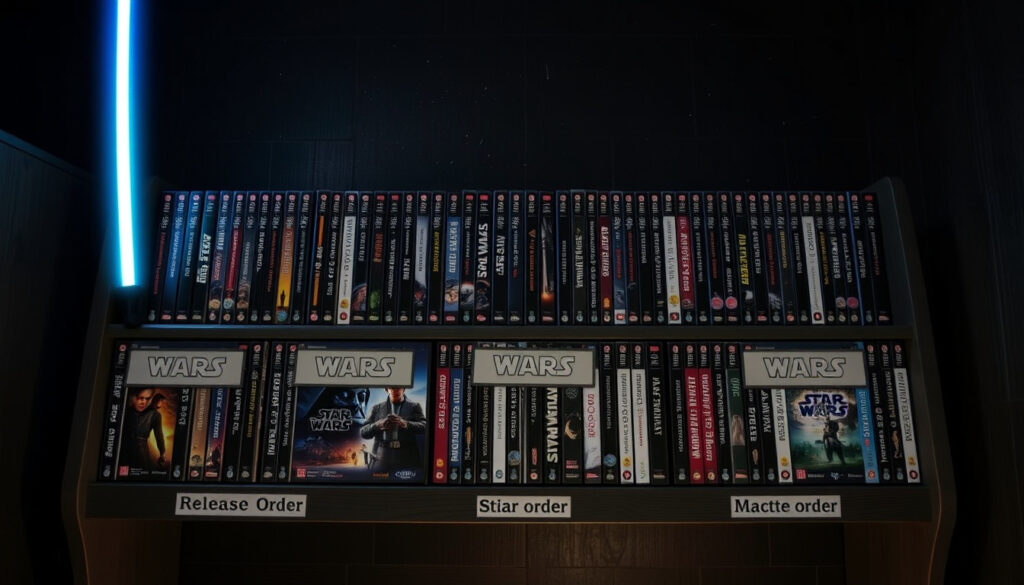
Star Wars Movies in Order: Release, Chronological & Machete
You’ve probably heard someone argue about the best way to watch Star Wars. Maybe a friend insisted on starting with Episode IV, while another swears by chronological story order. With decades of films, spin-offs, and streaming series, it’s easy to feel lost. This guide cuts through the noise, explains each viewing approach, and answers the common questions that trip up even seasoned fans.
First film release: 1977 ·
Total live-action films: 12 ·
Streaming home: Disney+
Quick snapshot
- First film released in 1977 (IMDb list)
- Baby Yoda is Grogu, not Yoda (Screen Rant guide)
- Luke milks a Thala-siren in The Last Jedi (Screen Rant guide)
- Exact name of Yoda’s species remains unknown (StarWars.com)
- Canon status of some expanded‑universe content under review (StarWars.com)
- Untitled Star Wars film planned for 2026 (StarWars.com)
- New theatrical release and multiple Disney+ series in development (StarWars.com)
Five key facts set the stage for any Star Wars viewing plan.
| Fact | Detail |
|---|---|
| First film release | May 25, 1977 (IMDb list) |
| Creator | George Lucas (Screen Rant guide) |
| Number of live‑action films | 12 (as of 2025) (Wikipedia entry) |
| Streaming platform | Disney+ (Disney+) |
| Upcoming film | Untitled Star Wars film (2026) (StarWars.com) |
The implication: these five facts anchor every viewing decision, from which trilogy to start with to how the 2026 film might fit into your marathon.
In what order do I watch Star Wars?
Three main approaches exist, and each serves a different purpose. The choice depends on whether you value narrative surprises, linear chronology, or a hybrid that balances both.
Release order: the original way
Watching in release order means starting with Episode IV – A New Hope (1977), followed by The Empire Strikes Back (1980), Return of the Jedi (1983), then the prequels (Episode I through III). This is how audiences first experienced the story. The original trilogy’s twists — Vader as Luke’s father, the Emperor’s reveal — hit exactly as they were designed, because the prequels hadn’t been made yet. For first‑time viewers who want the purest emotional journey, release order remains the default recommendation.
Six films in release order: IV (1977), V (1980), VI (1983), I (1999), II (2002), III (2005) — IMDb list.
Chronological order: story timeline
Chronological order follows the in‑universe timeline: Episode I (set about 30 years before the original trilogy) through Episode IX. This approach gives a linear narrative — Anakin’s rise and fall, the Rebellion, and the rise of the First Order. The trade‑off: it spoils the reveal that Anakin becomes Vader, since you see his story from the start. It also places the weakest films (some argue The Phantom Menace) at the beginning, which can deter new viewers.
Machete order: a fan variant
Rod Hilton introduced Machete Order in 2011 as a suggested viewing sequence for the six‑film saga. The order is IV, V, II, III, VI — skipping Episode I entirely. The idea is to preserve the big reveals from the original trilogy while inserting the prequels as a flashback after the Empire Strikes Back’s cliffhanger. Hilton’s reasoning: Episode I adds little to the core story, and its removal keeps the narrative tight. IMDb’s list labels Machete Order a “workaround that avoids the prequel trilogy’s pitfalls” while maintaining a spoiler‑free environment for first‑time viewers. The catch: it only covers the original six films, so you’ll need to decide how to integrate the sequels.
“The core Machete Order is IV, V, II, III, VI. Episode I is removed entirely.”
The pattern: each order prioritizes a different experience — surprise, coherence, or narrative architecture — so the choice depends on what you value most as a viewer.
What is the chronological order of Star Wars?
Episode I–III: the prequel trilogy
Set about 30 years before the original trilogy, the prequels follow Anakin Skywalker from boyhood to his fall as Darth Vader. The films: The Phantom Menace (1999), Attack of the Clones (2002), and Revenge of the Sith (2005). The trilogy ends with the rise of the Galactic Empire and the separation of Luke and Leia.
Episode IV–VI: the original trilogy
Luke Skywalker’s journey from farm boy to Jedi Knight, the destruction of the Death Star, and the redemption of Anakin. Released between 1977 and 1983, these films defined the franchise and remain its most critically acclaimed entries.
Episode VII–IX: the sequel trilogy
Set about 30 years after Return of the Jedi, the sequels introduce Rey, Finn, and Kylo Ren. The trilogy includes The Force Awakens (2015), The Last Jedi (2017), and The Rise of Skywalker (2019).
Complete chronological sequence: I, II, III, IV, V, VI, VII, VIII, IX — confirmed by Screen Rant guide.
Why is Star Wars 4 5 6 1 2 3?
George Lucas’s numbering explanation
George Lucas originally wrote the story as Episodes IV–VI, not I–III. The numbering was part of his plan from the start: he intended the original trilogy to be the middle of a larger saga. When he later made the prequels, they were labeled Episodes I–III to fit the existing numbers. This explains why the film series begins with Episode IV — Lucas always envisioned the story beginning “in the middle.”
Why the story started in the middle
Lucas has said he started with Episode IV because it was the most exciting part of the story — the Rebellion against the Empire. Prequels, he believed, would work better after audiences already cared about the characters. The result is a narrative that jumps back in time after the original trilogy, which is why the release order feels natural to so many fans.
New viewers who start with Episode I lose the original trilogy’s best surprises. Experienced fans who re‑watch in release order rediscover how carefully Lucas constructed the saga’s structure.
The implication: Lucas’s numbering decision means release order isn’t arbitrary — it reflects the storyteller’s original intent.
Is Baby Yoda actually Yoda?
Grogu’s identity
Baby Yoda is officially named Grogu. He was introduced in the Disney+ series The Mandalorian and is a member of the same unknown species as Yoda. Unlike Yoda, Grogu is a child — about 50 years old at the time of the series — and is still training in the Force.
Relationship to Yoda
Grogu is not Yoda. Yoda died in Return of the Jedi at the age of 900. The two share a species, but no direct familial connection has been established in canon. Dave Filoni, executive producer of The Mandalorian, has described Grogu as “a character who carries the echo of Yoda but is his own distinct person.”
“Grogu carries the echo of Yoda but is his own distinct person. That’s what makes him compelling.”
Dave Filoni, executive producer of The Mandalorian (Screen Rant guide)
What Star Wars movie is Pedro Pascal in?
Pedro Pascal’s role in The Mandalorian
Pedro Pascal voices and portrays the Mandalorian, Din Djarin, in the Disney+ series The Mandalorian. The series debuted in 2019 and spans three seasons, with a fourth confirmed. Pascal appears primarily in the title role, though much of the action is done by stunt performers while he provides the voice and physical presence for key scenes.
The Mandalorian series vs. films
As of 2025, Pedro Pascal has not appeared in any mainline Star Wars theatrical film. His work is confined to the streaming series, which is set between Return of the Jedi and The Force Awakens. This distinction is important for viewers looking for his performances: all three seasons of The Mandalorian are available on Disney+.
Did Vader ever meet Yoda?
Anakin Skywalker and Yoda’s encounters
As a Jedi, Anakin Skywalker meets Yoda many times — in the Jedi Council chamber, during the Clone Wars, and in training. Yoda is his teacher and later his opponent when Anakin turns to the dark side.
Darth Vader and Yoda’s conflict
As Darth Vader, he fights Yoda in Revenge of the Sith (2005). After that confrontation, Yoda goes into exile on Dagobah, and the two never interact again in the films or in canon animated series. The final meeting between Yoda and any Skywalker is with Luke in The Empire Strikes Back and Return of the Jedi.
What did Luke Skywalker milk?
Green milk explained
In Star Wars: The Last Jedi (2017), Luke Skywalker milks a creature for a green‑colored liquid, which he drinks. The scene was widely discussed for its weirdness and practical‑effect authenticity.
The Thala-siren creature
The creature is a Thala-siren, a large, seal‑like animal native to the island planet Ahch‑To. The green milk is its natural product, used by Luke as a food source during his exile. Director Rian Johnson confirmed the scene used a practical puppet and real milk (colored green) to achieve the effect.
That green milk is one of the most‑asked questions from new viewers. It’s a simple practical effect, but the lack of explanation in the film leaves many fans wondering what they just watched.
Timeline
- 1977 – Star Wars: Episode IV – A New Hope released (IMDb list)
- 1980 – The Empire Strikes Back released (IMDb list)
- 1983 – Return of the Jedi released (IMDb list)
- 1999 – The Phantom Menace released, begins prequel trilogy (Wikipedia entry)
- 2005 – Revenge of the Sith released, ends prequel trilogy (Wikipedia entry)
- 2015 – The Force Awakens released, begins sequel trilogy (StarWars.com)
- 2019 – The Rise of Skywalker released, ends sequel trilogy (StarWars.com)
Confirmed facts vs. what remains unclear
Confirmed facts
- Star Wars: Episode IV – A New Hope was released in 1977.
- Baby Yoda is Grogu, not Yoda.
- Luke milked a Thala-siren in The Last Jedi.
What’s unclear
- The exact name of Yoda’s species remains unknown.
- The official canonical status of some expanded universe content is under review.
The pattern: more facts are confirmed than disputed, but the open questions — species names and canon boundaries — keep the lore alive for dedicated fans.
“I always saw Star Wars as a story that starts in the middle. The prequels were the backstory, but the emotional core was always the original trilogy.”
For a new viewer, the choice of order is not just about timeline — it’s about preserving the magic of the reveals that made Star Wars a global phenomenon. Release order respects the story as it was told; chronological order respects the in‑universe history; Machete order respects the narrative architecture. The pattern is clear: no single order fits everyone. The trade‑off is between surprise and coherence, and that depends on what you value most.
Related reading: Guy Ritchie Movies: Complete Filmography Guide · Bridget Jones Diary: Films, Cast, Watch Order Guide
For those seeking the best way to experience the saga, this complete Star Wars viewing guide offers a thorough breakdown of release, chronological, and Machete orders.
Frequently asked questions
Is Star Wars 4 5 6 1 2 3 the correct viewing order?
That’s release order. It’s the way the films were originally presented and is widely considered the best order for first‑time viewers because it preserves the original trilogy’s twists. It’s not “correct” in a chronological sense, but it’s the order most fans recommend.
What is the best way to watch Star Wars for the first time?
Release order (IV, V, VI, I, II, III) is the most popular recommendation. It avoids spoilers and lets you experience the story as it unfolded. If you want to include the sequels, add VII, VIII, IX after the first six.
Does the chronological order spoil the story?
Yes — the biggest spoiler is that Anakin Skywalker becomes Darth Vader. If you start with Episode I, you already know the ending of the original trilogy. If that doesn’t bother you, chronological order provides a linear narrative.
What is the Machete order and is it recommended?
Machete order (IV, V, II, III, VI) skips Episode I. It’s designed to preserve the Empire Strikes Back cliffhanger while using the prequels as a flashback. It’s a niche order, but fans who dislike The Phantom Menace often prefer it.
How many Star Wars movies are there in total?
As of 2025, 12 live‑action films have been released, plus two animated films (The Clone Wars and Star Wars: The Clone Wars). The total number includes the original trilogy, prequel trilogy, sequel trilogy, and standalone films like Rogue One and Solo.
Are the Star Wars movies available on Disney+?
Yes — all mainline Star Wars films and series are available on Disney+, including The Mandalorian, The Book of Boba Fett, and upcoming shows.
What is the next Star Wars movie coming out?
An untitled Star Wars film is scheduled for release in 2026. Details about the director, cast, and plot have not been officially announced as of early 2025.
More related posts
 Isha Time Sydney: Accurate Hanafi & Shafi Timings (Today 2025)
 La Roche-Posay B5: Uses, Benefits, Reviews & Comparisons
 Rick and Morty Season 3 Episode 1: Plot, Cast, Recast Explained
 Wesley Snipes: What Happened? Prison, Tax Case, Career Comeback
 Ryobi Whipper Snipper – Best Models Guide 2024
 Vivienne Westwood: Biography, Net Worth, and Legacy
 Heated Towel Rail: Worth It? Electricity Use & Install Guide
 Buster Keaton: The Silent Star’s Life, Death, and Legacy
